The Cinema and the Museum
This week: two Singapore landmarks turned into a judged competition and a folklore canvas, a moving light that folds a pixel-mappable screen into its own face, and 250-plus fixtures across two stages at Ultra Europe.
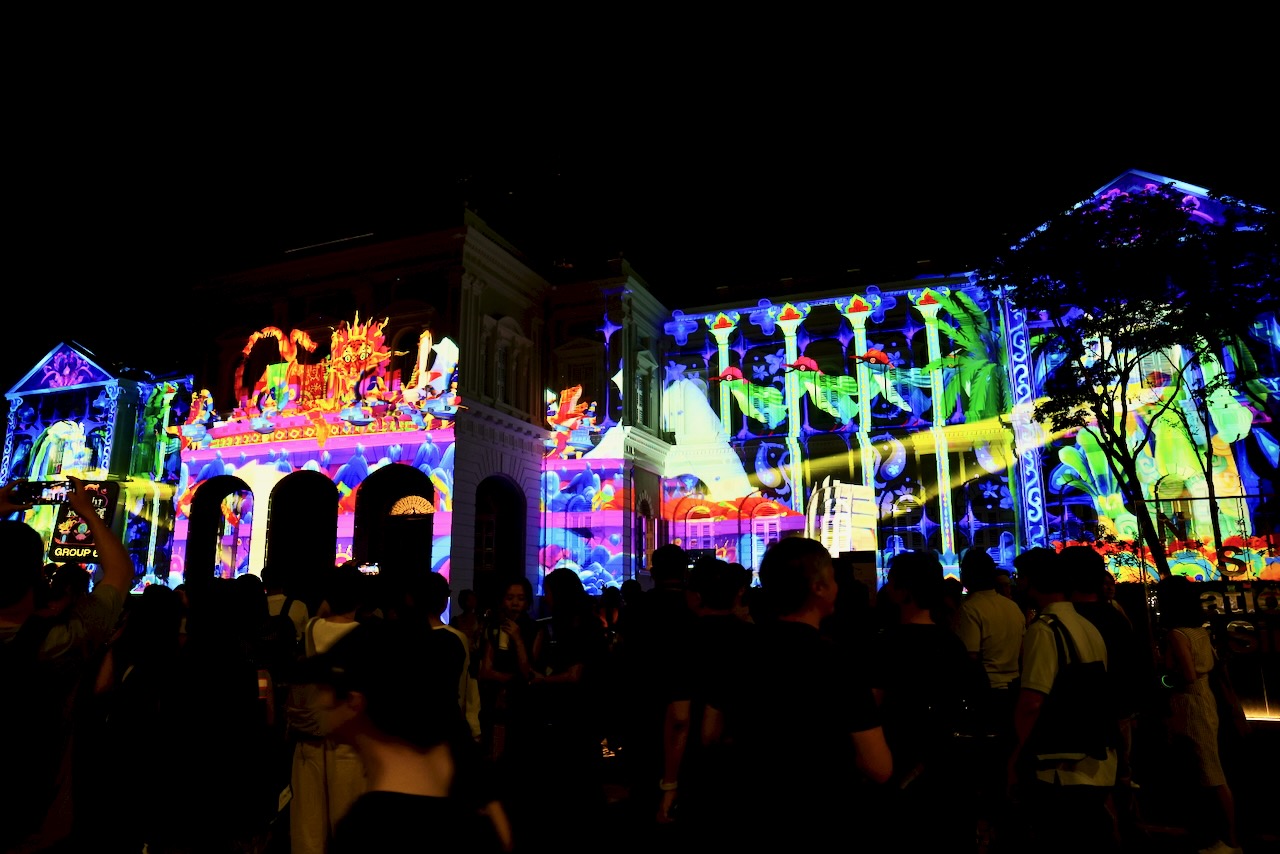
On The Cathay's Art Deco facade in Singapore — a cinema built in 1939 — eighteen projection-mapping entries from across Southeast Asia have been screening nightly since August 21, competing for a verdict that doesn't land until the 28th. MALAM is the Singapore Night Festival's first projection-mapping competition, and its format runs backward from the usual order: the work goes up before it's judged, and the top five keep screening for another week regardless of what the panel decides that night. Epson supplied the projectors — its EB-L30000U throwing 30,000 lumens at the old cinema's facade. A short walk away, the National Museum of Singapore's neoclassical front carries a different kind of canvas: Tales of Earth and Sea, made by the Bandung-based collective The Fox, The Folks with an original score by Artusik and UiTM Malaysia, reworking Southeast Asian folklore as ongoing tidal and geological process rather than fixed myth. Both run nightly, free, through September 5.
A 1939 cinema hosts a projection-mapping competition that keeps running after the verdict
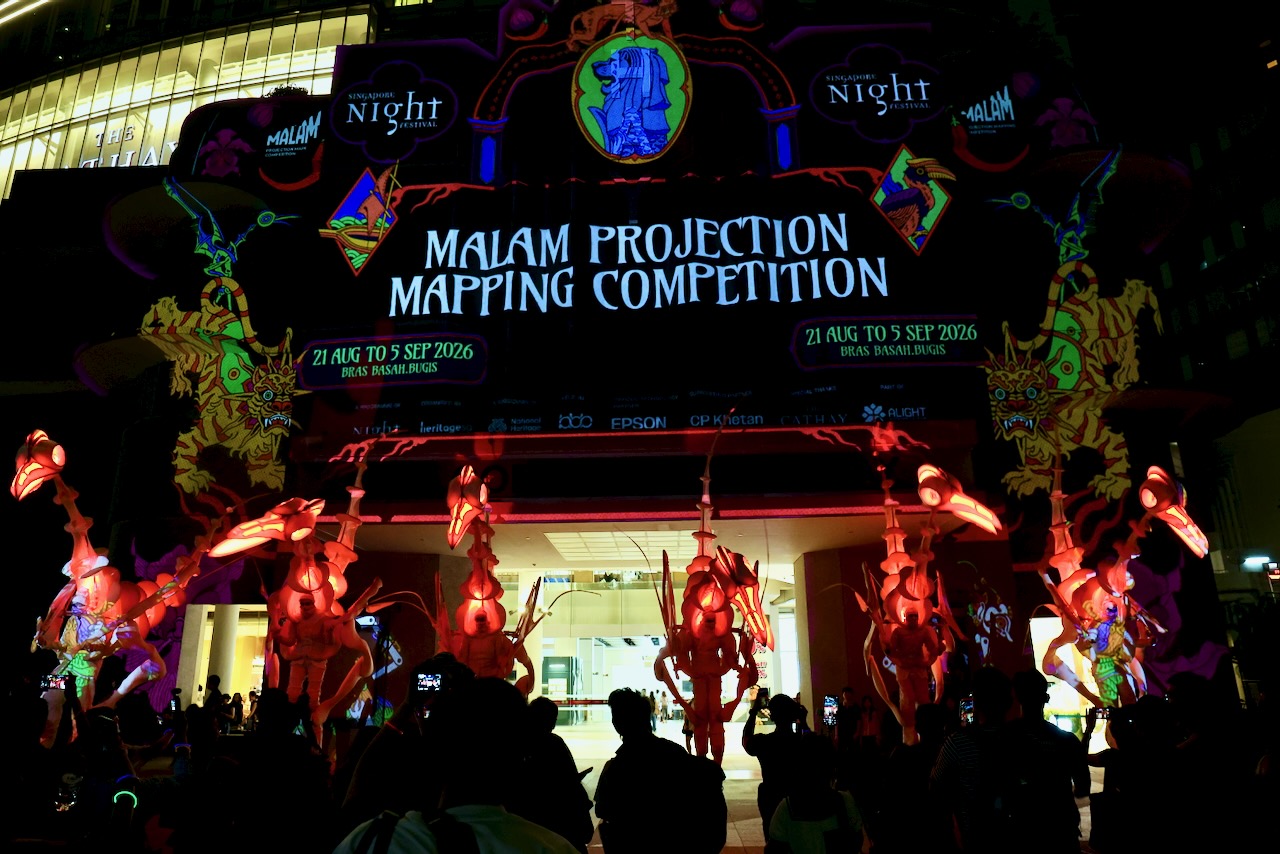
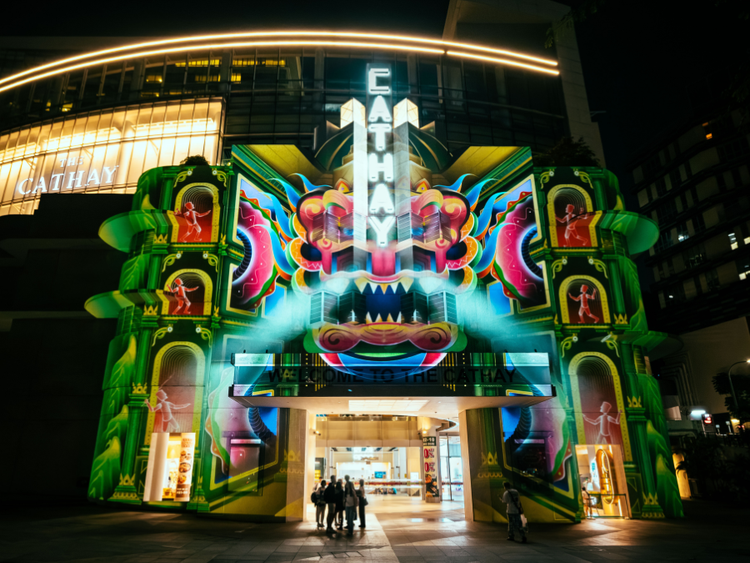
MALAM narrowed a regional open call down to eighteen finalists, screening nightly on The Cathay's facade from 21 to 28 August; the top five keep running through the festival's close rather than stopping once a winner is picked. Epson's EB-L30000U projectors, rated at 30,000 lumens, do the throwing. A short walk from The Cathay, the National Museum of Singapore's neoclassical front carries a single continuous piece instead of a competition: Tales of Earth and Sea, made by the Bandung-based collective The Fox, The Folks with an original score from Artusik and UiTM Malaysia, reworking Southeast Asian folklore as ongoing tidal and geological process rather than a fixed tale. Both run nightly and free through 5 September, as part of the wider Singapore Night Festival.
Portman Lights folds a pixel-mappable screen into a fixture's own face
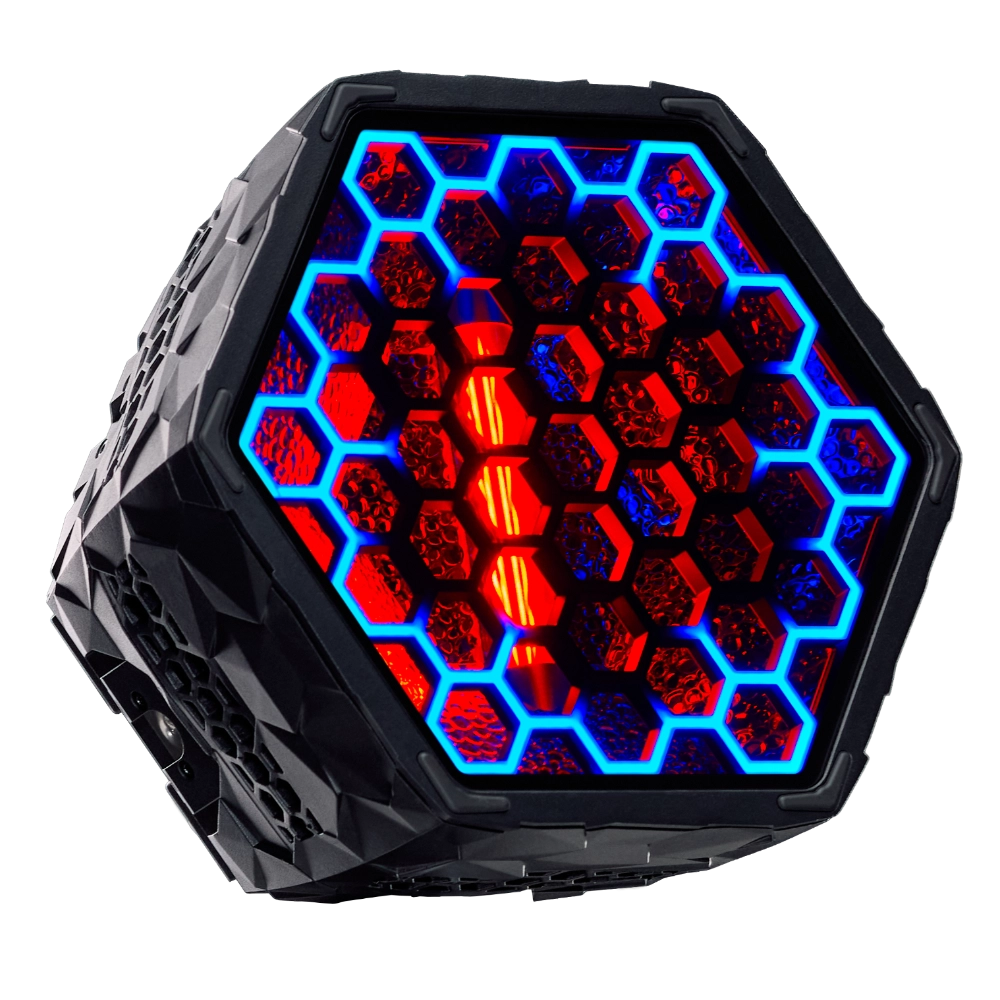
HEXY — Photo courtesy Portman Lights 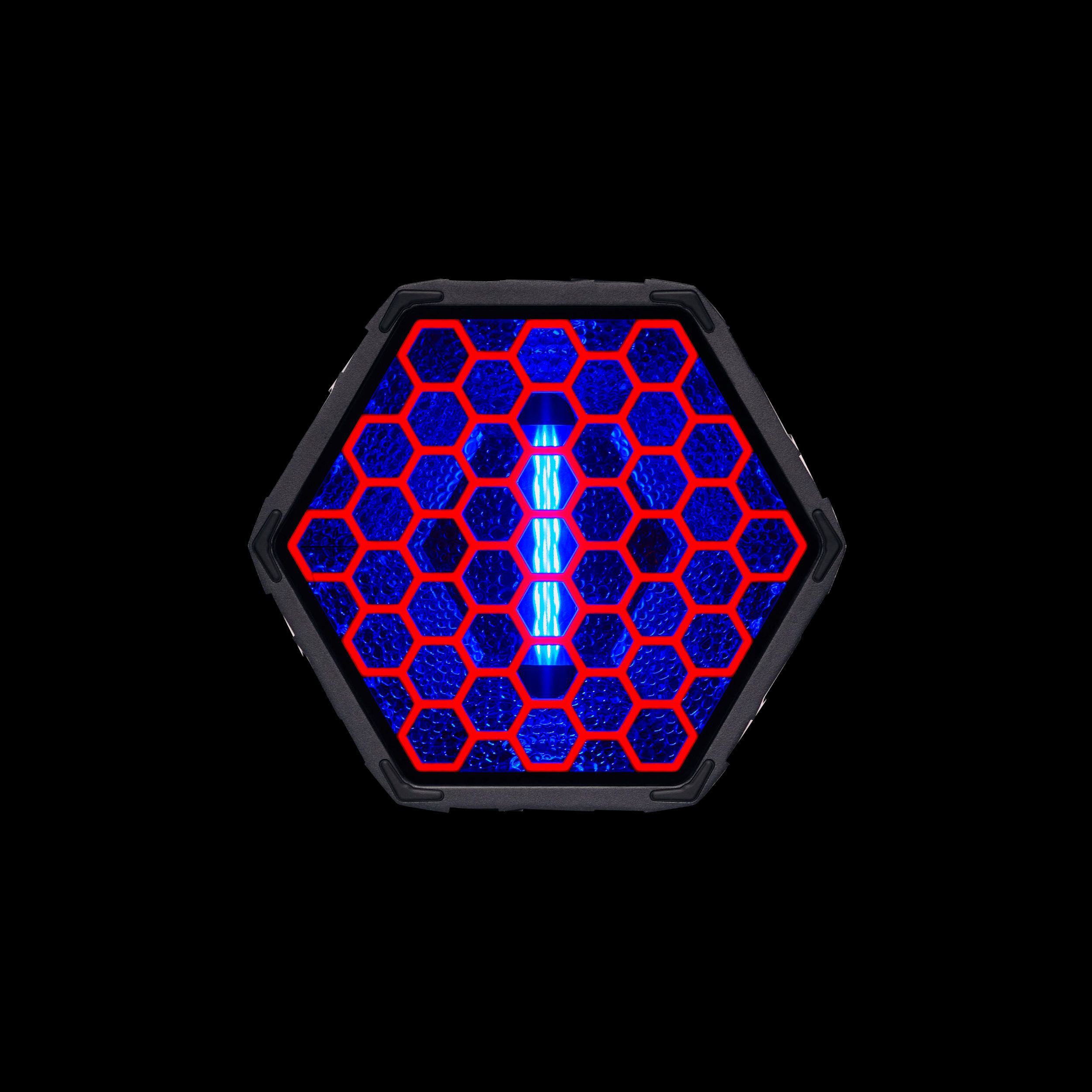
HEXY — Photo courtesy Portman Lights 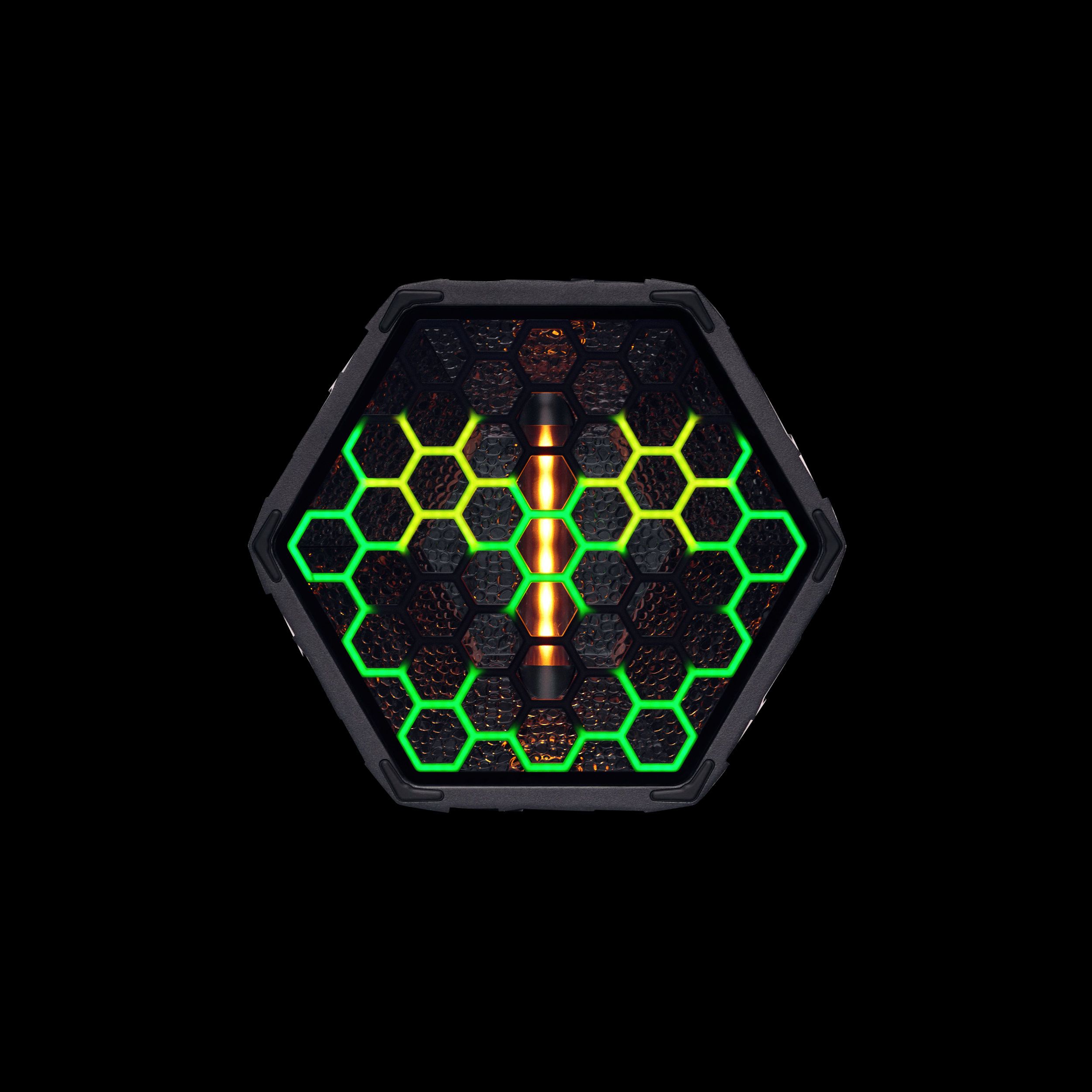
HEXY, SMESH mesh pattern detail — Photo courtesy Portman Lights
HEXY carries two separate light engines behind one hexagonal face: a 120W warm-white plus 90W RGB main source putting out 3,500 lumens between 1600K and 3200K, and a second, independent 30W RGB engine — SMESH — built into the fixture's own protective mesh, split into thirteen pixel-mappable zones. The mesh that would normally just guard the lens becomes a low-resolution display in its own right, addressable over the same DMX universe as the main beam across seven control modes, 9 to 94 channels. It's IP65-rated at 6.5kg. Portman Lights frames it as a distillation of the brand's first decade — doubling the core power and turning the front mesh into a pixel-mappable canvas, inside one sealed cell, to mark the company's tenth anniversary.
via Portman Lights ↗
250-plus Robe fixtures, two stages, two production teams, one shared number at Ultra Europe
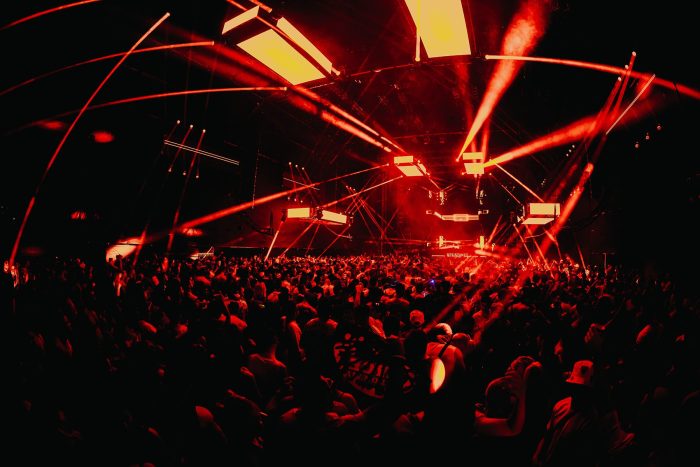
Ultra Europe 2026, Split, Croatia — Photo: Andro Tasovac 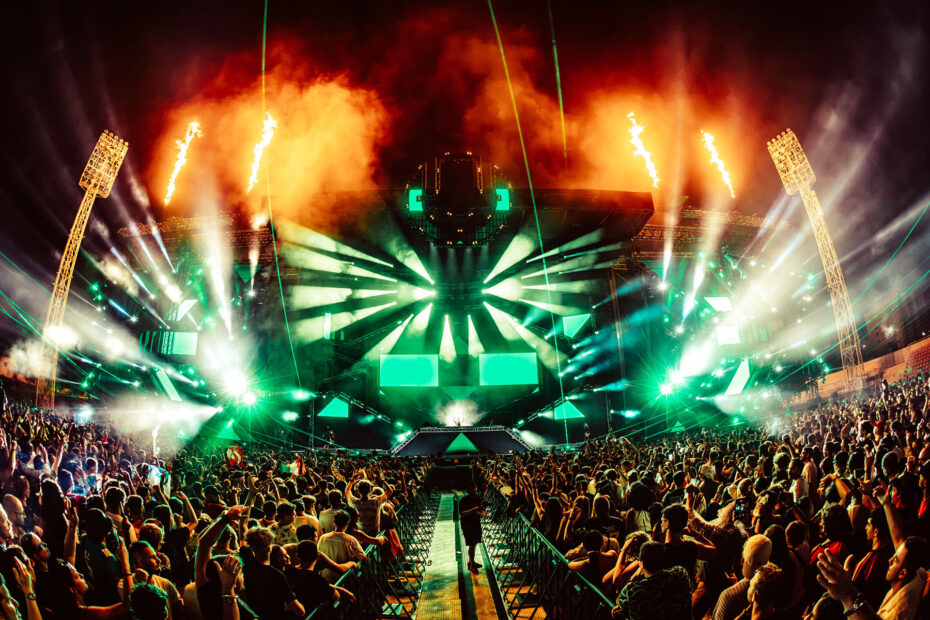
Ultra Europe 2026 Main Stage — Photo: Julien Duval, courtesy Robe / PLSN 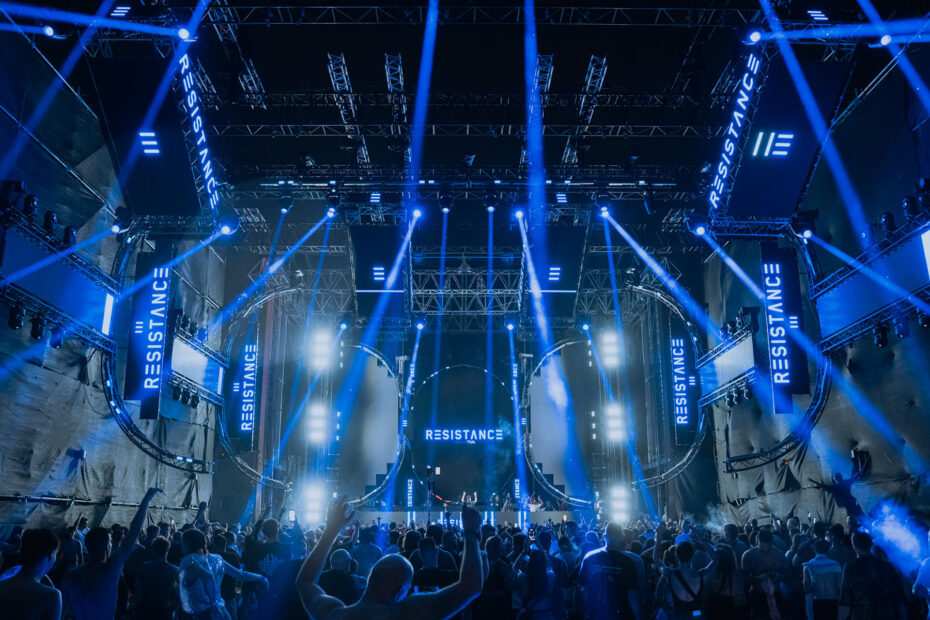
Ultra Europe 2026, RESISTANCE stage — Photo: Luka Brajkovic, courtesy Robe / PLSN
Richard Milstein and Ray Steinman designed Ultra Europe's Main Stage this July in Split, Croatia — Steinman doubling as production manager and executive producer — with Alex "Junior" Cerio of JuniorCorp running house lighting design and programming and Alessandro Scotellaro of Effetto Laser handling the laser side. The Main Stage carried 12 Robe GigaPointes, 52 FORTEs (44 standard plus 8 iFORTEs), 60 Spiiders and 98 MegaPointes; guest sets for Martin Garrix, BUNT and Calvin Harris brought their own lighting designers — Fabian Fisniku, Matthew Dean and Jade Fraser — on top of the house rig. Serafin Gonzalez designed the separate RESISTANCE stage, where another 42 GigaPointes brought the festival's combined GigaPointe count to 54 across both stages. MOJO Rental Southeast Europe and Event Lighting Slovenia supplied and ran the gear on site.
via TPi Magazine ↗
Janet Echelman suspends 103 kilometers of fiber over a Frankfurt plaza, lit by 24 fixtures mounted on its own support pylons
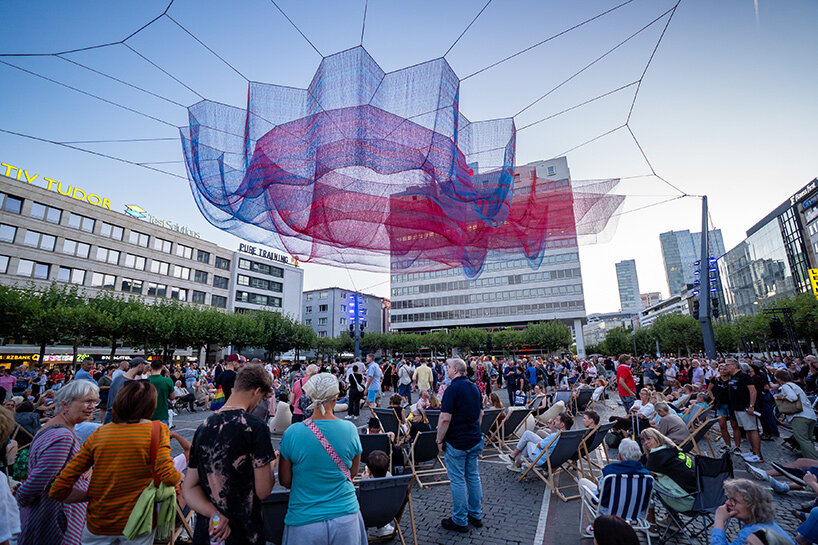
A Sky Full of Hope – Earthtime 1.78 Frankfurt, Konstablerwache — Photo: Holger Menzel, © Stadt Frankfurt am Main 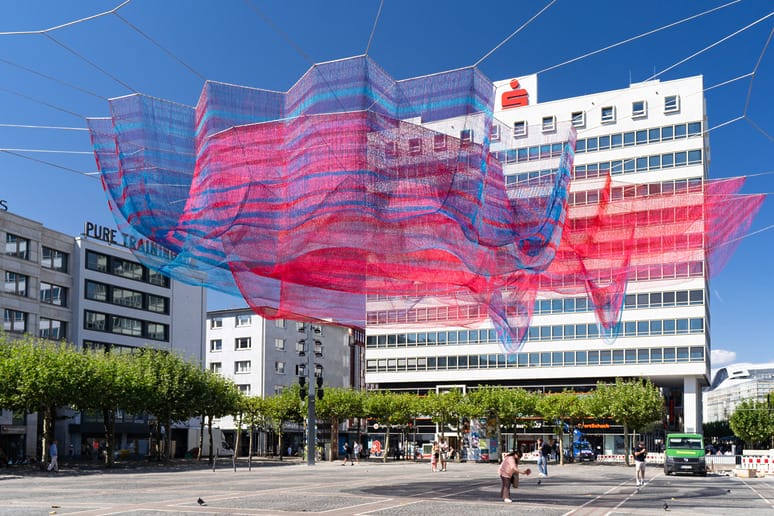
A Sky Full of Hope – Earthtime 1.78 Frankfurt, daytime — Photo: Holger Menzel, © Stadt Frankfurt am Main 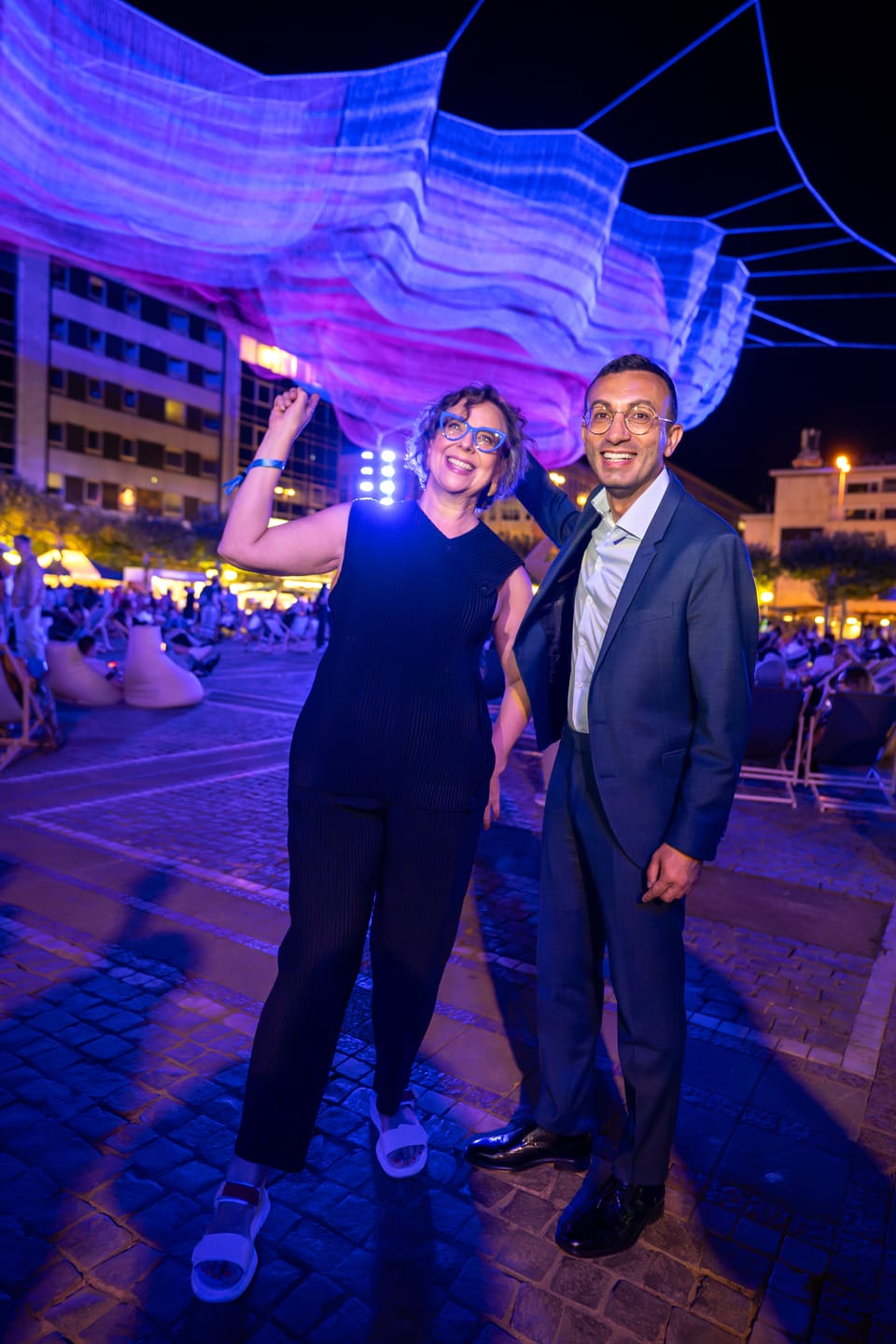
Janet Echelman with Frankfurt Mayor Mike Josef at the unveiling — Photo: Holger Menzel, © Stadt Frankfurt am Main
A Sky Full of Hope – Earthtime 1.78 Frankfurt unveiled 11 August over Konstablerwache, a central Frankfurt square, as a commission for World Design Capital Frankfurt RheinMain 2026. The net itself is hand-spliced high-strength polymer fiber — about 103 kilometers of twine, knotted in traditional fishing-net technique, with colored segments up to 4.5 meters long — suspended more than seven meters up and left to move however the wind moves it; Echelman has said she composes the conditions for the piece but not its outcome. Lighting designer Alexander Orkisch of TLD Planungsgruppe specified 24 Cameo ZENIT W600 G2 IP65 wash fixtures, distributed across the four pylons that also carry the net's own rigging, supplied and installed by Neumann & Müller. The title's "1.78" is a double reference: the 178 nationalities living in Frankfurt, and the microseconds the 2011 Tōhoku earthquake shaved off Earth's rotation. It's planned to stay up roughly three years.
via designboom ↗
Robin Fox — PRESENCE closing concert
Melbourne — the free Town Hall run closed 27 August; a ticketed full concert closes the festival on 30 August.
teamLab Borderless — On the Asymmetry of the Universe
Tokyo, Azabudai Hills — through 8 October. A new special exhibition reopening the "Light Sculpture — Flow" zone with two new series.
via teamLab ↗
Phoebe Bridgers routed a tour backward — small rooms first, arenas last — and it's worth reading as a strategy, not a quirk
J.R. Lind's piece traces how Bridgers rolled out the Lost Weekend tour: eighteen unannounced pop-up shows in secondary markets first, 150-to-500-cap rooms at roughly $50 a ticket, in towns her booking agent Dave Rowan deliberately kept off any advance schedule specifically so nobody would fly in from out of town — the opposite of how routing usually optimizes for reach. A $1-entry lottery show at Madison Square Garden and a run of planetarium listening events with dome-projected visuals came before the arena leg, which itself grew from an announced 34 dates to 45, all of them selling out. It's a routing philosophy built around not exporting a hometown show to strangers, and it's a more interesting document than most tour-strategy writeups because it has the numbers to back the claim up.
via Pollstar ↗
Curated by Neves Creative. Every item links to its original source.