Whoever Decides What It's For
A field of hanging bulbs in a Prague park becomes a crowd from one spot and nowhere else, 221 camera obscuras run on sunlight and record nothing, and the job title invented to avoid paying an engineering salary turns out to name the decision everything else depends on.
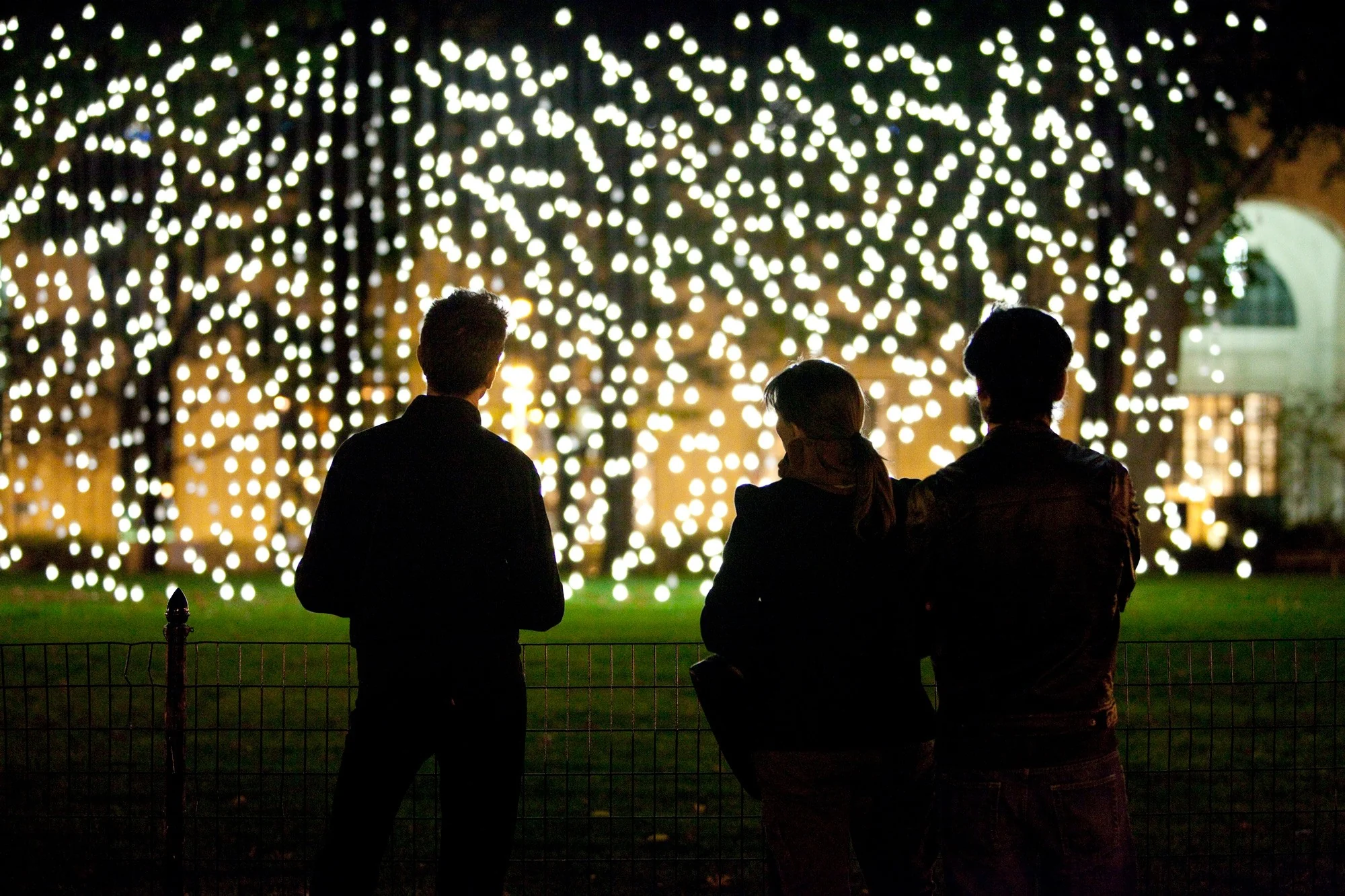
Signal Festival's own page describes Jim Campbell's Scattered Light as "a monumental constellation of suspended light bulbs, gently flickering in the darkness." Stand in the wrong place and that is all it is. Stand in the right one and, in Signal's account, fleeting human figures emerge from the glow and dissolve again. Campbell built it first for Madison Square Park in New York, and his own site gives the whole method in one sentence: "The randomness of the matrix creates an image that is only visible from certain perspectives." It is in General Lázaro Cárdenas Park in Prague 6 this week, 15 to 18 October, 19:00 to 24:00, running continuously. The man who made it trained as an engineer, and the piece reads like it: a picture built so that it only exists if you walk to the spot where it works.
Whoever Decides What It's For
The title
Cella, a staffing firm, says creative technologists are "now at the forefront of innovation, pushing boundaries and redefining how brands, agencies and studios tell stories and build experiences. They're not just executing ideas; they're inventing and building them." That is the demand side talking, and it is the version with the most to sell.
The salary
Tina Tarighian starts earlier. Everyone with something to sell needed a storefront on the internet and engineers to build it, she writes, and then: "To forgo the engineering salary, they invented a new title, slapped it under the marketing umbrella, and started recruiting from the growing pool of mystics who could talk to people and computers with the same suavity."
The job
Blair Neal, writing for people starting out, puts the cost plainly: "It's hard to find a corner of the industry that feels like it suits your interests and strengths that also allows you to make a living." On the work itself he is blunter — "Live events don't wait for you." A title coined to avoid paying for engineers now names the one job in the room that decides what the technology is for. This week's work is that job at four sizes: a park, a six-sided arena, an inflatable full of lenses and a nineteenth-century stage.
A field of hanging bulbs turns into a crowd if you stand in the right place
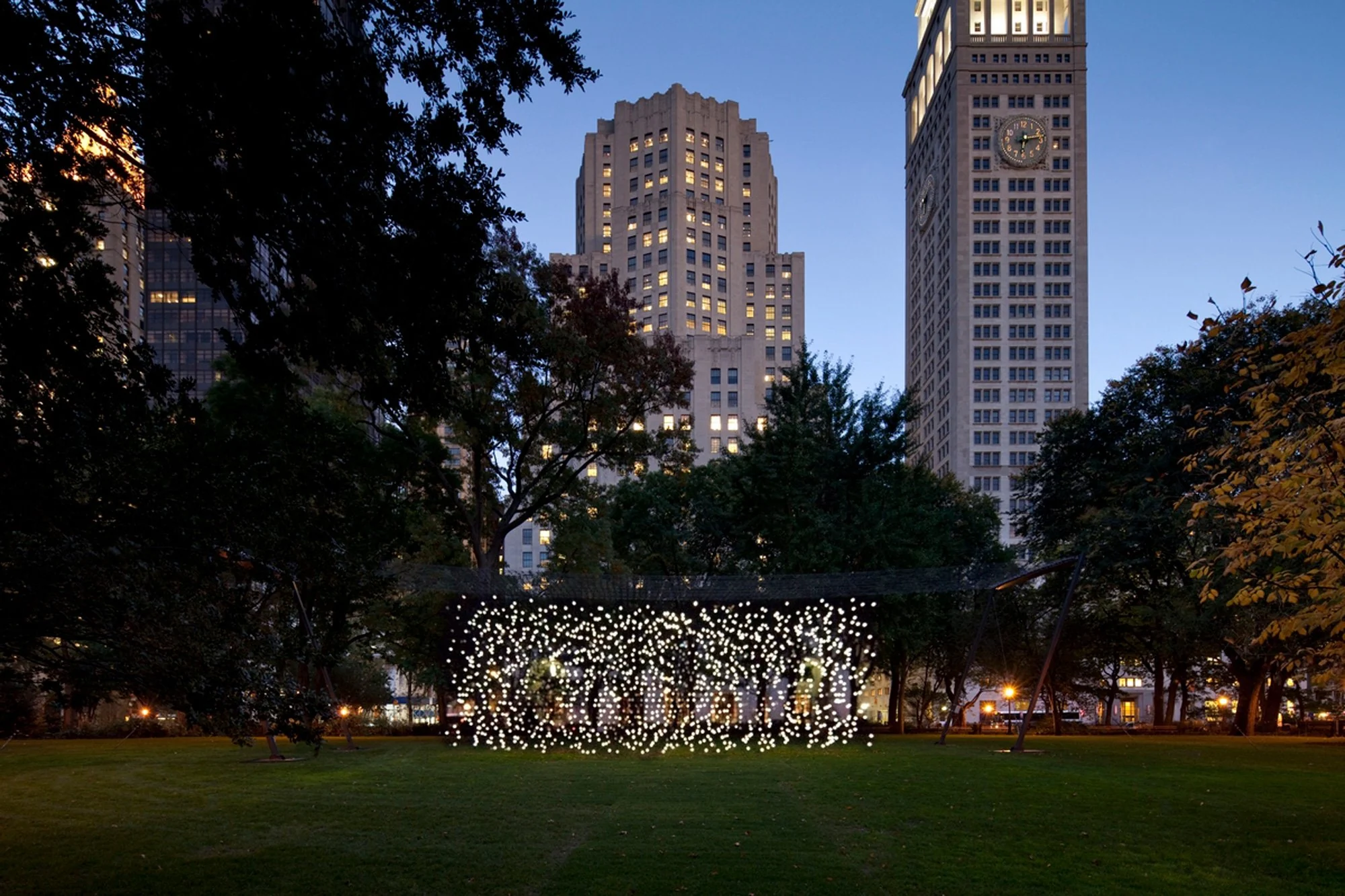
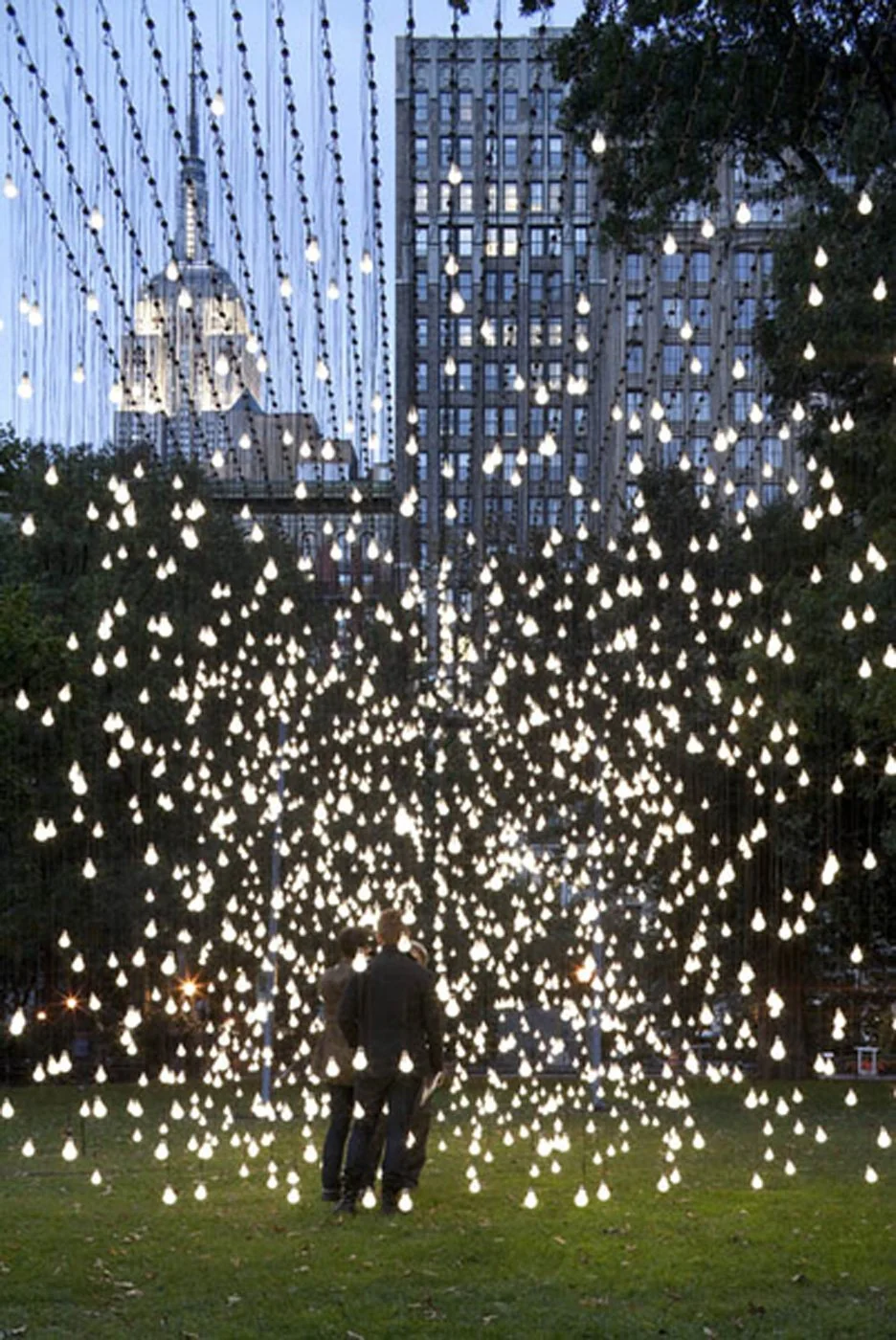
Campbell's own page gives the spec without adjectives: Scattered Light, 2010, 20 × 80 × 16 feet, "1536 modified light bulbs, steel cable and uprights, and custom electronics", originally commissioned by the Madison Square Park Conservancy, and since shown in New York, St Paul, Perth and Hong Kong. The bulbs hang in a three-dimensional box, and the image they carry is of commuters crossing Grand Central Station. Signal's page counts "more than 1500 points of light" in Prague and gives no dimensions for this edition. The Conservancy's own text says "almost 2,000 LEDs" — that is the museum's wording, not the artist's, and the figure to carry is the 1536 on Campbell's materials line. The photographs here are from the New York installation, not Prague.
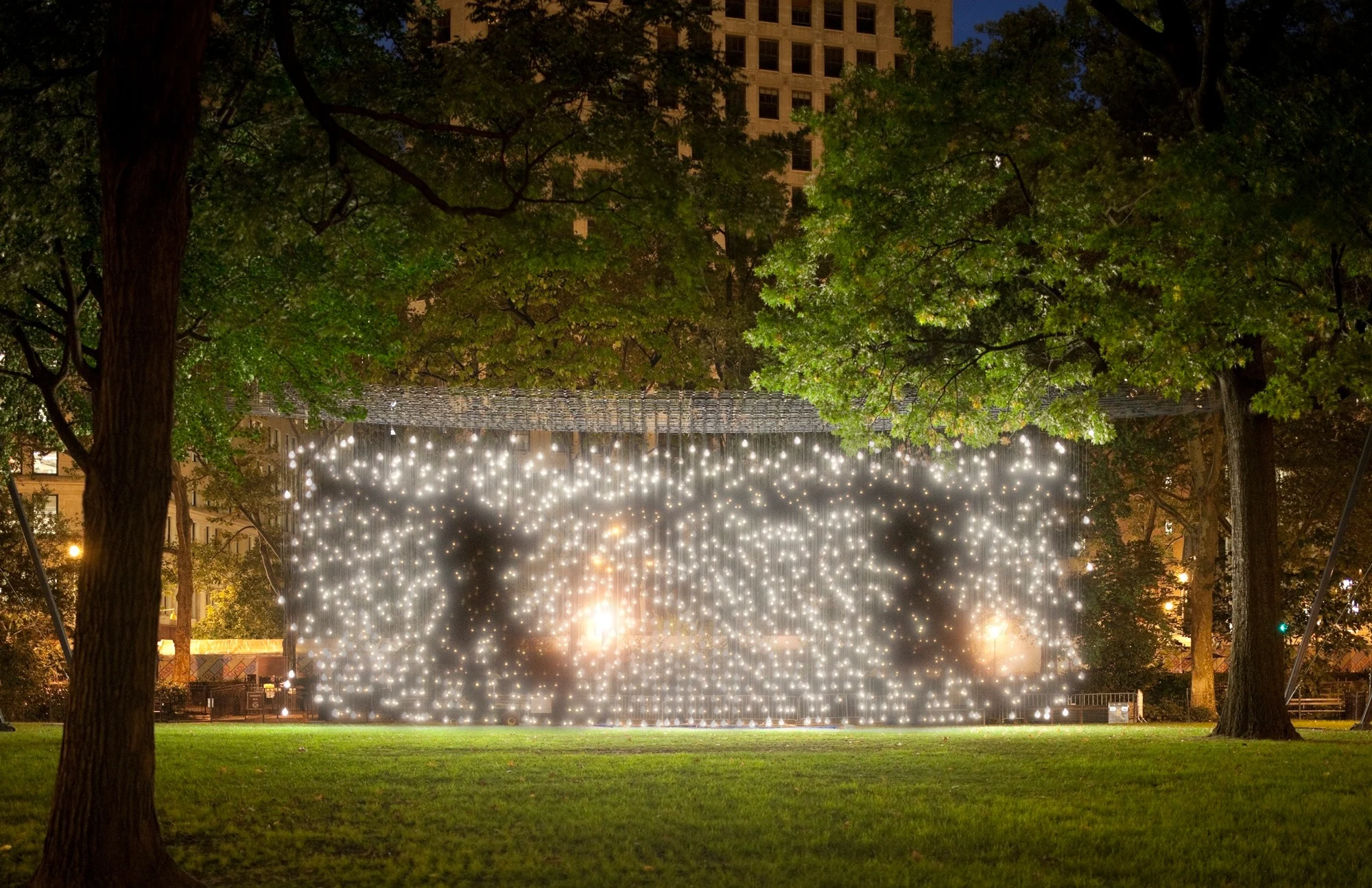
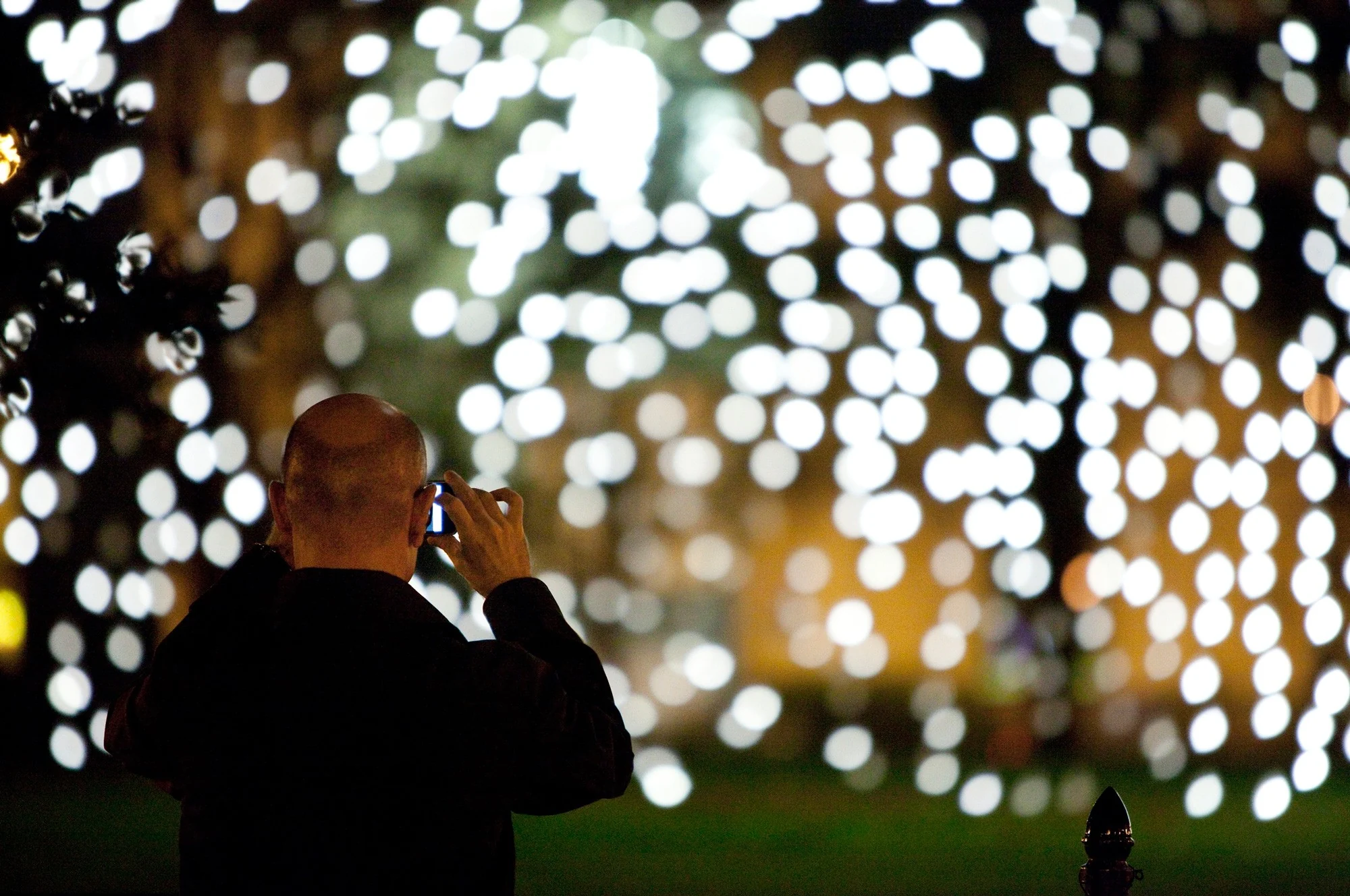
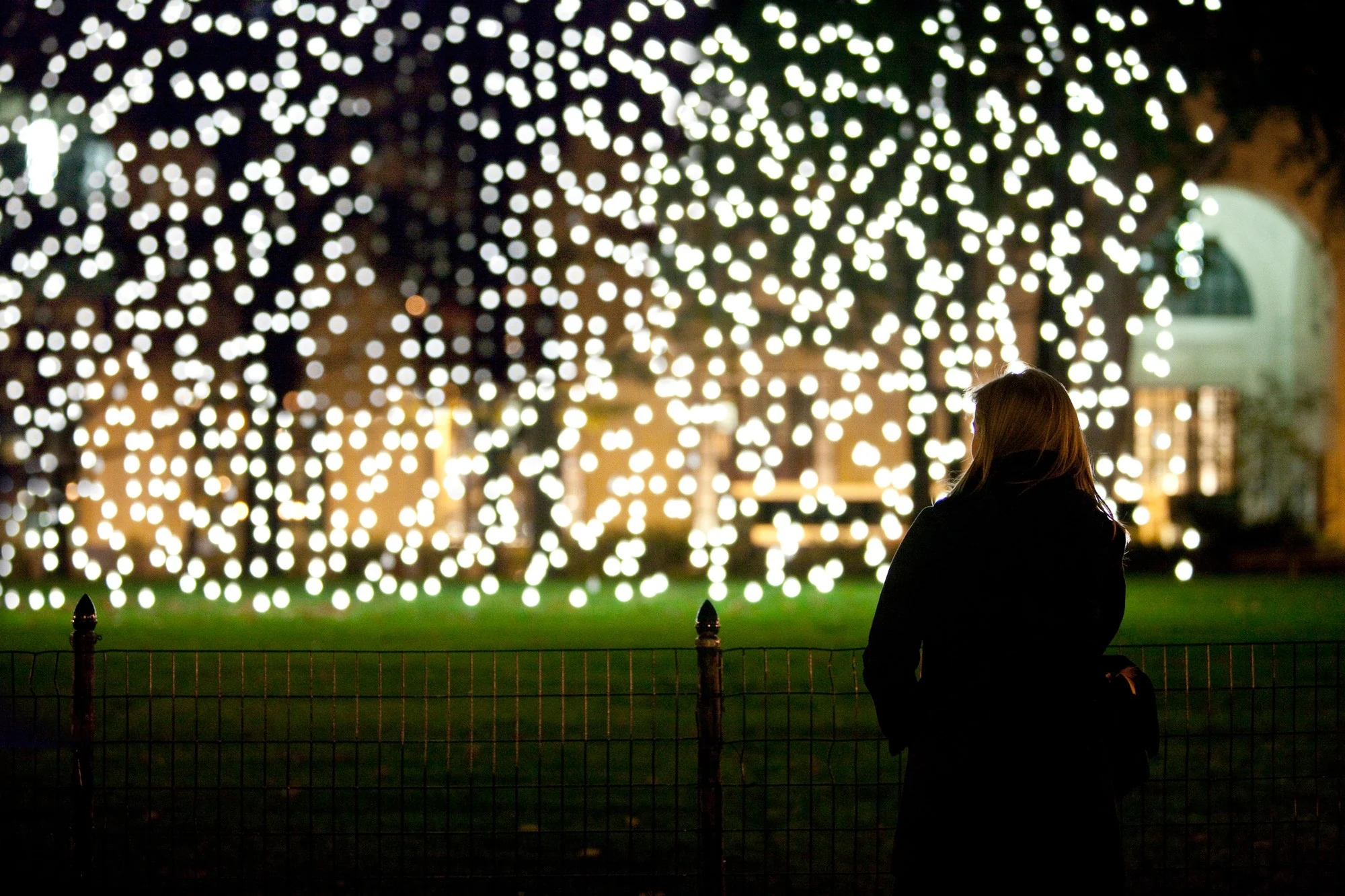
Resolution is the design variable, and he is spending it in the opposite direction from everyone else. Our work adds pixels until the picture is unambiguous; this removes them until the picture exists only from one vantage, which makes the viewer's position the last component in the system — the one part of the build that cannot be commissioned, rehearsed or signed off. Note what that does to the siting drawing. A screen can go anywhere the sightlines clear; this has to be aimed, because the geometry of the matrix decides where the image is, and a park path in the wrong place would simply delete the work. Nothing on the pages we read says how the bulbs are driven or powered, which is the first thing we would ask. Four nights, free, on Signal's schedule.
Six screens in a hexagon, and the show changes with your seat
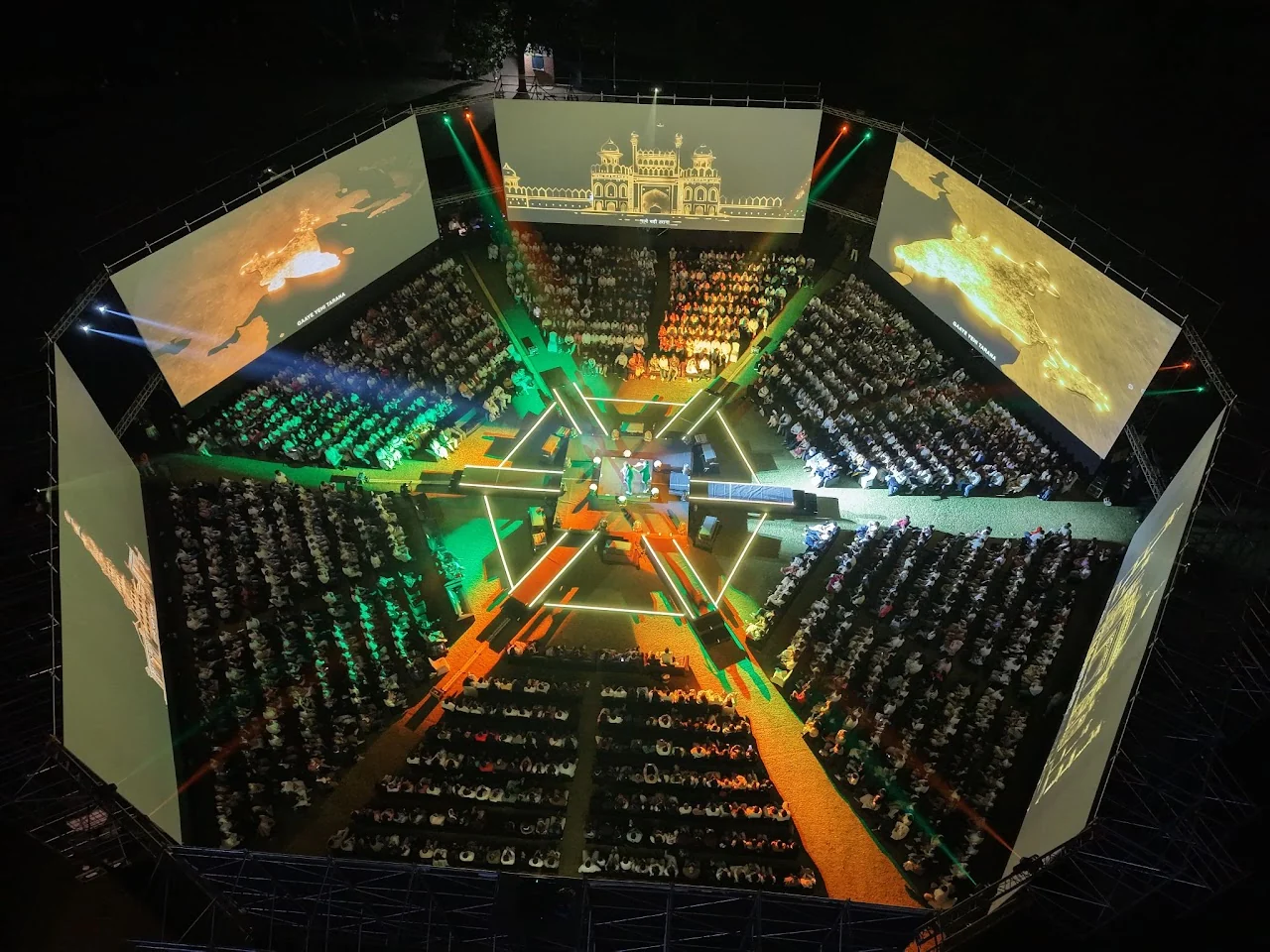
HEXAIMMERSIVE, Mumbai. Courtesy Set Design Magazine 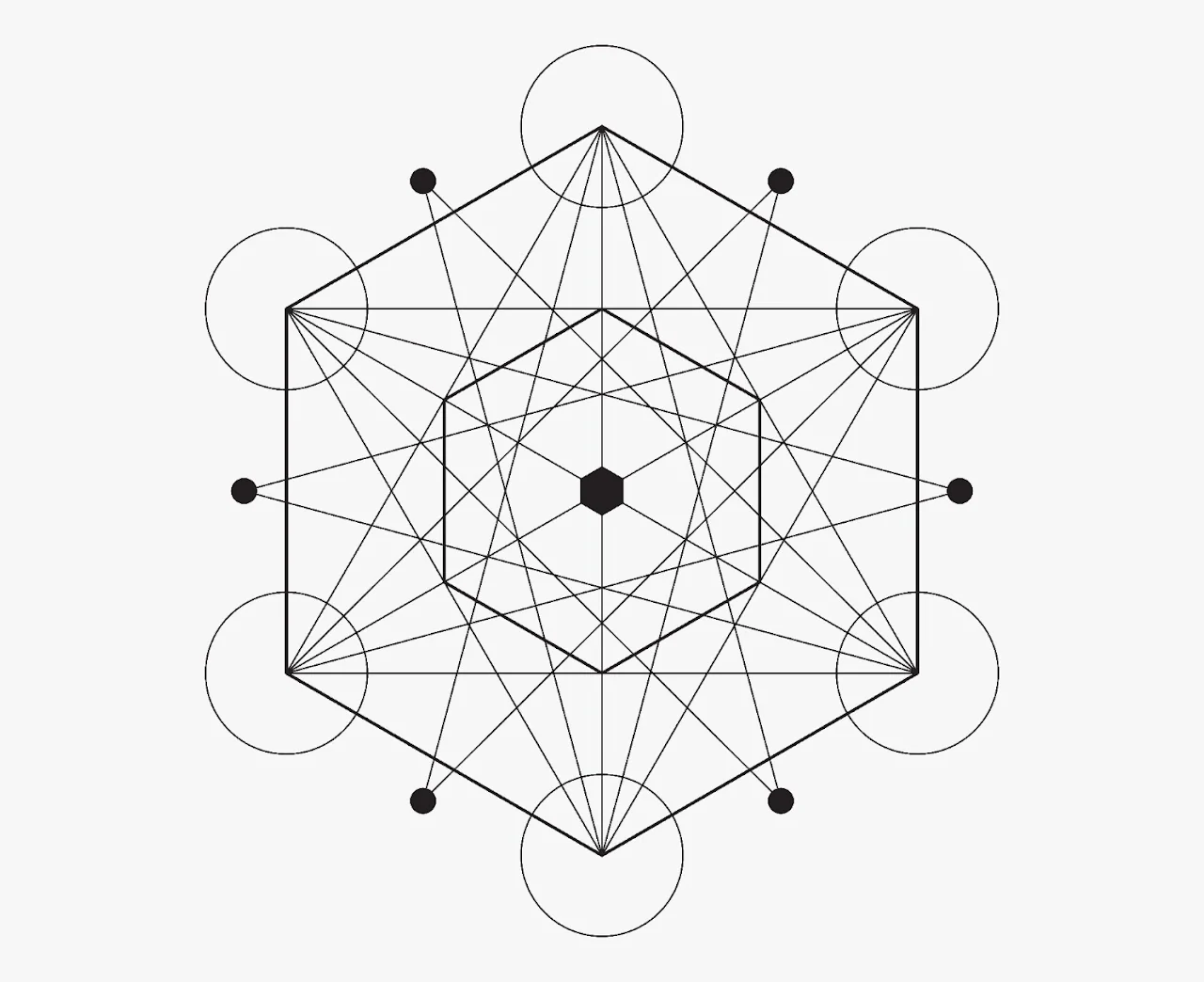
Courtesy Set Design Magazine 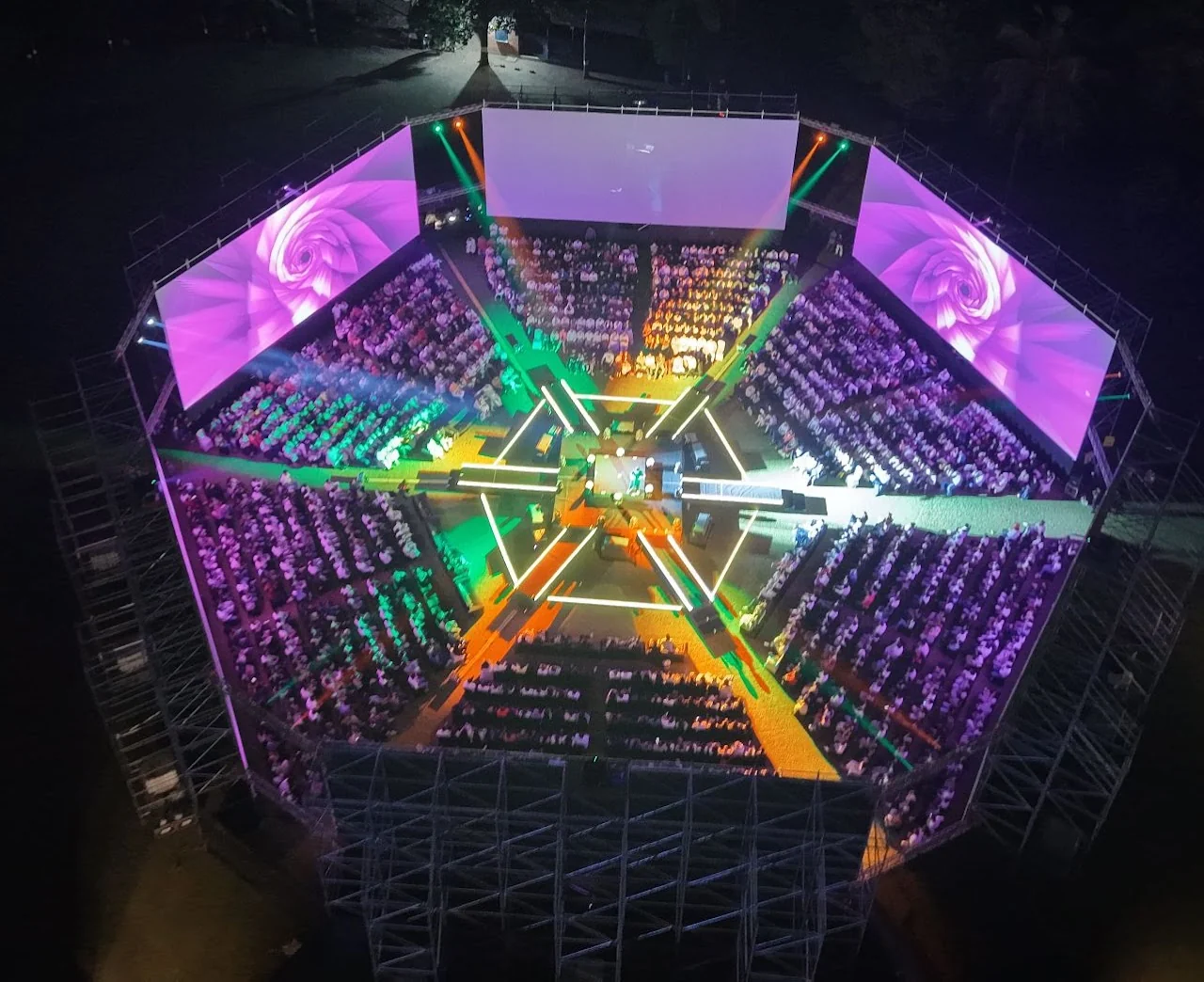
Courtesy Set Design Magazine 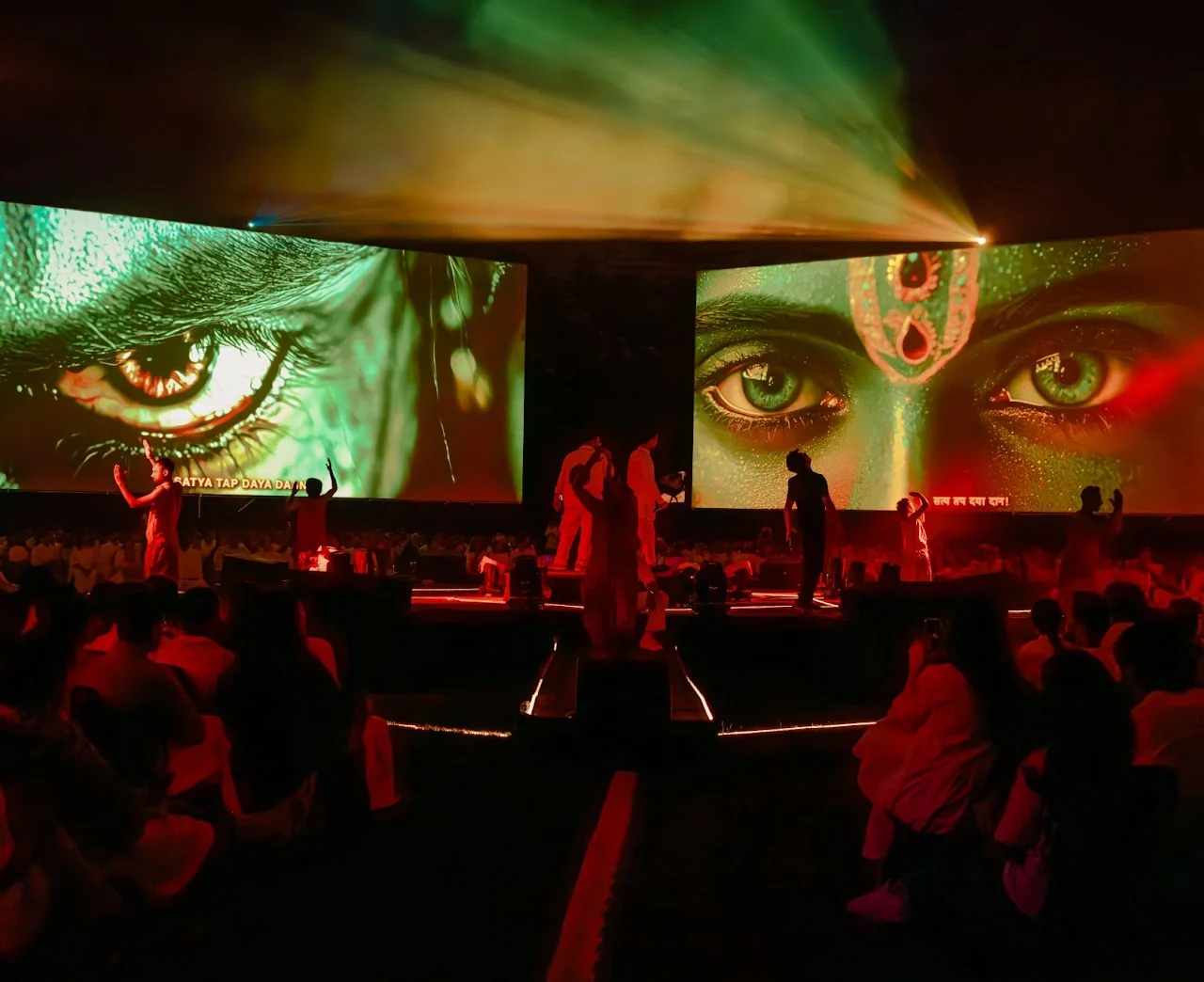
Courtesy Set Design Magazine 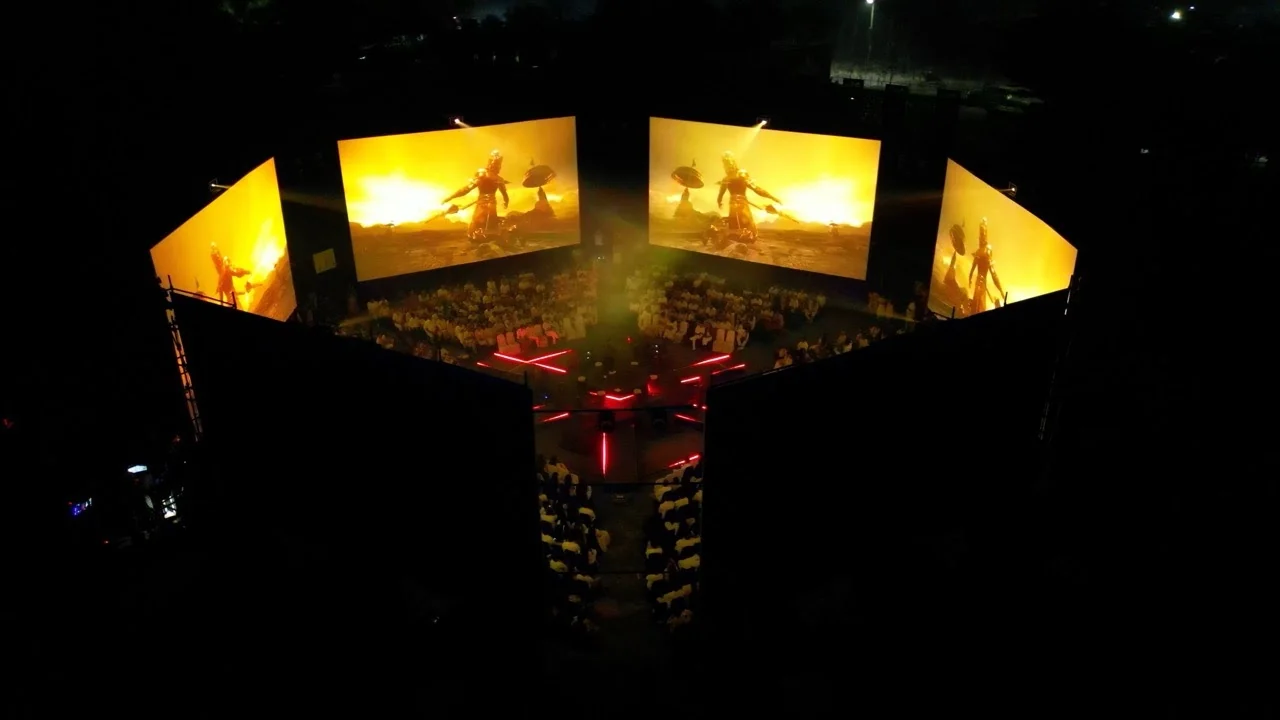
Courtesy Set Design Magazine 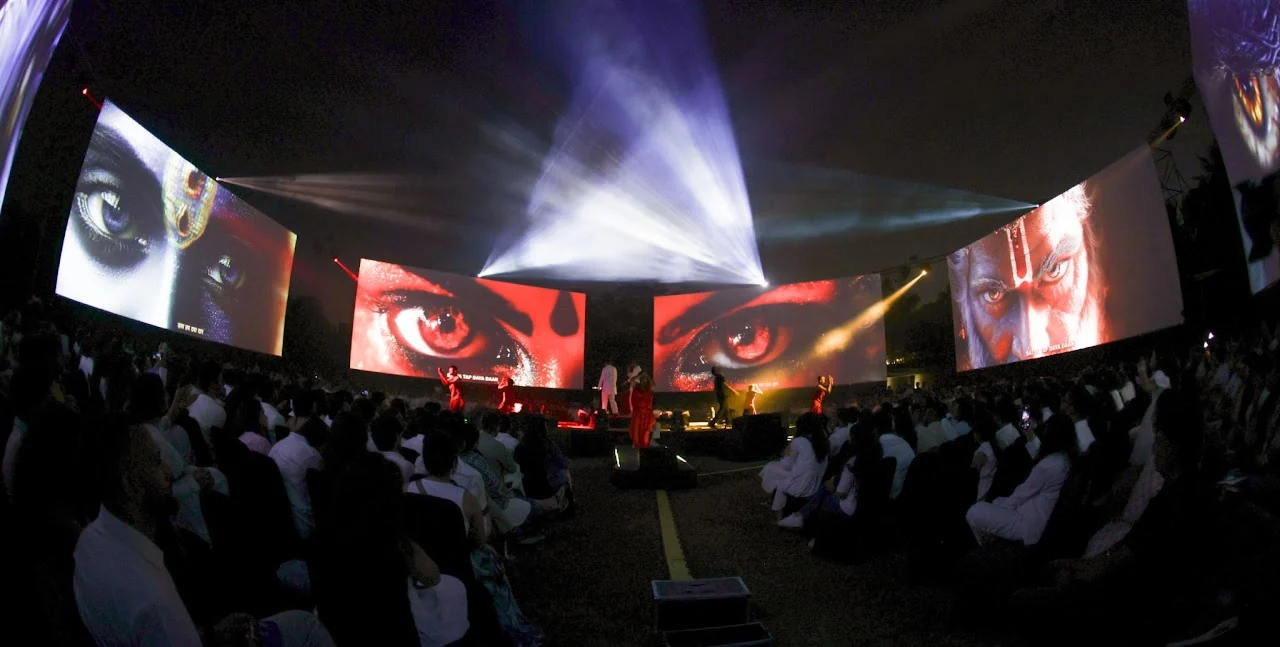
Courtesy Set Design Magazine
Hrutul, an artist from Ahmedabad, built a concert format called HEXAIMMERSIVE around six projection surfaces arranged in a hexagon. Set Design Magazine describes six triangular audience sections facing inward, with projectors "positioned on opposing axes" making "intersecting beams that form a luminous star-like geometry" above the arena, and an audience dressed in white so the light lands on bodies and fabric. The six screens, it says, can show six views of one scene, "a unified 360-degree spatial world, or opposing 180-degree narratives". For the Mumbai production the magazine reports each surface measured over 75 feet wide and nearly four storeys high. The format was made for the storytelling concert YOUFORIA chp. पार्थ, built from 18 original compositions drawing on Indian history, the Ramayana, the Mahabharata and Vedic philosophy while arguing with artificial intelligence, capitalism, identity and social media. Its credit line reads "Concept, Design, Direction, Lyrics, Composition, Screenplay & Dialogues: @_hrutul", and it describes him as director, writer, composer, lyricist, designer and live narrator. Pune, Delhi and Bengaluru are listed as upcoming, without dates.
A hexagon breaks the rule every screen-based show otherwise shares, that the whole room sees the same picture. Content has to be authored for six faces at once by someone who knows no one can watch all six, so the piece a spectator receives depends on where they sat and where they chose to look — a continuity problem with no standard toolset behind it. The page names no projector, server or screen type, so the build itself is still unexplained. What the page does give is authorship: one person holding the story, the score and the sightline problem, which is the creative-technologist job in a single credit line.
221 lenses, powered by the sun, recording nothing
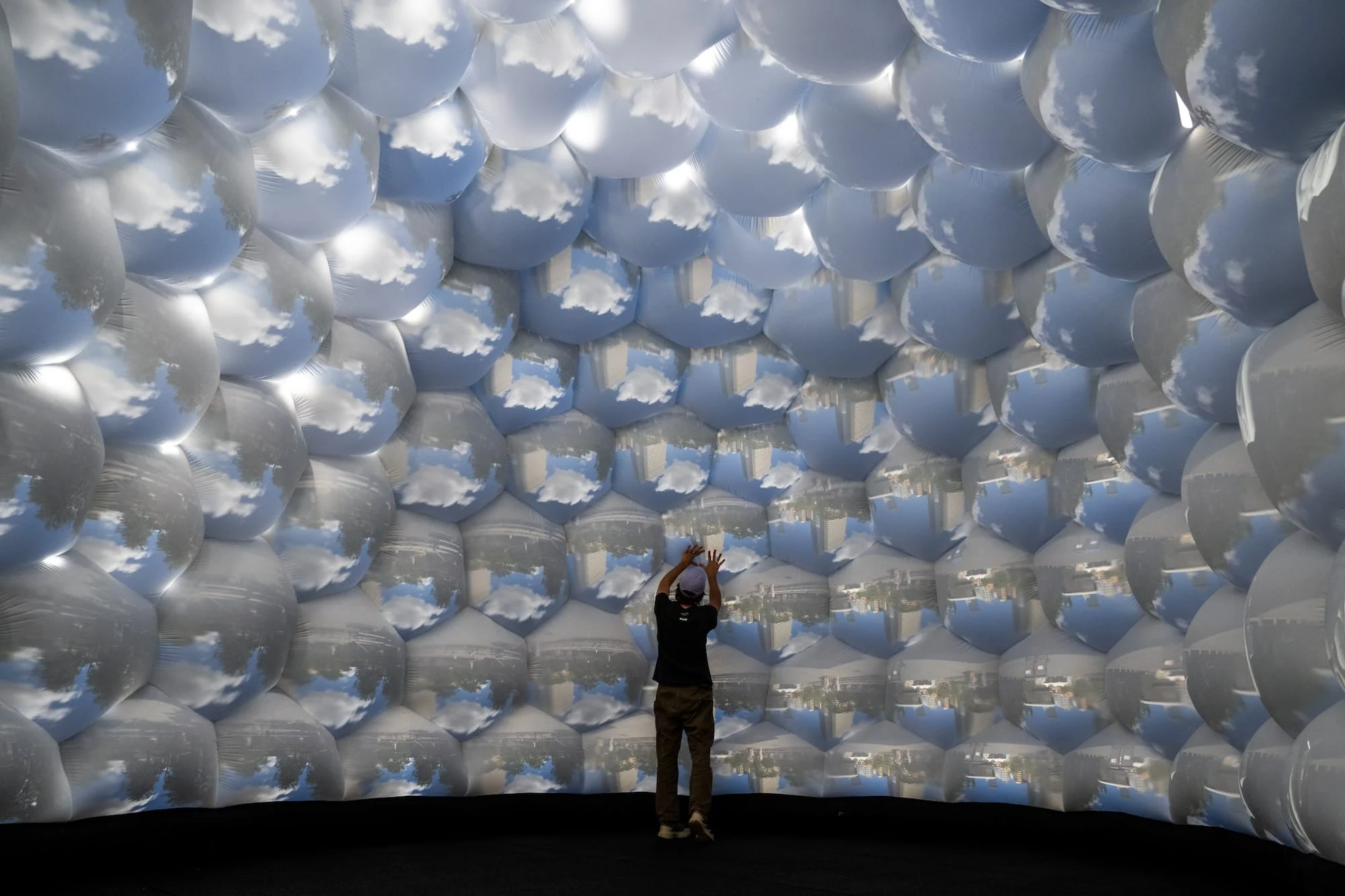
Photo: Lachlan Turczan. Courtesy Pneuhaus 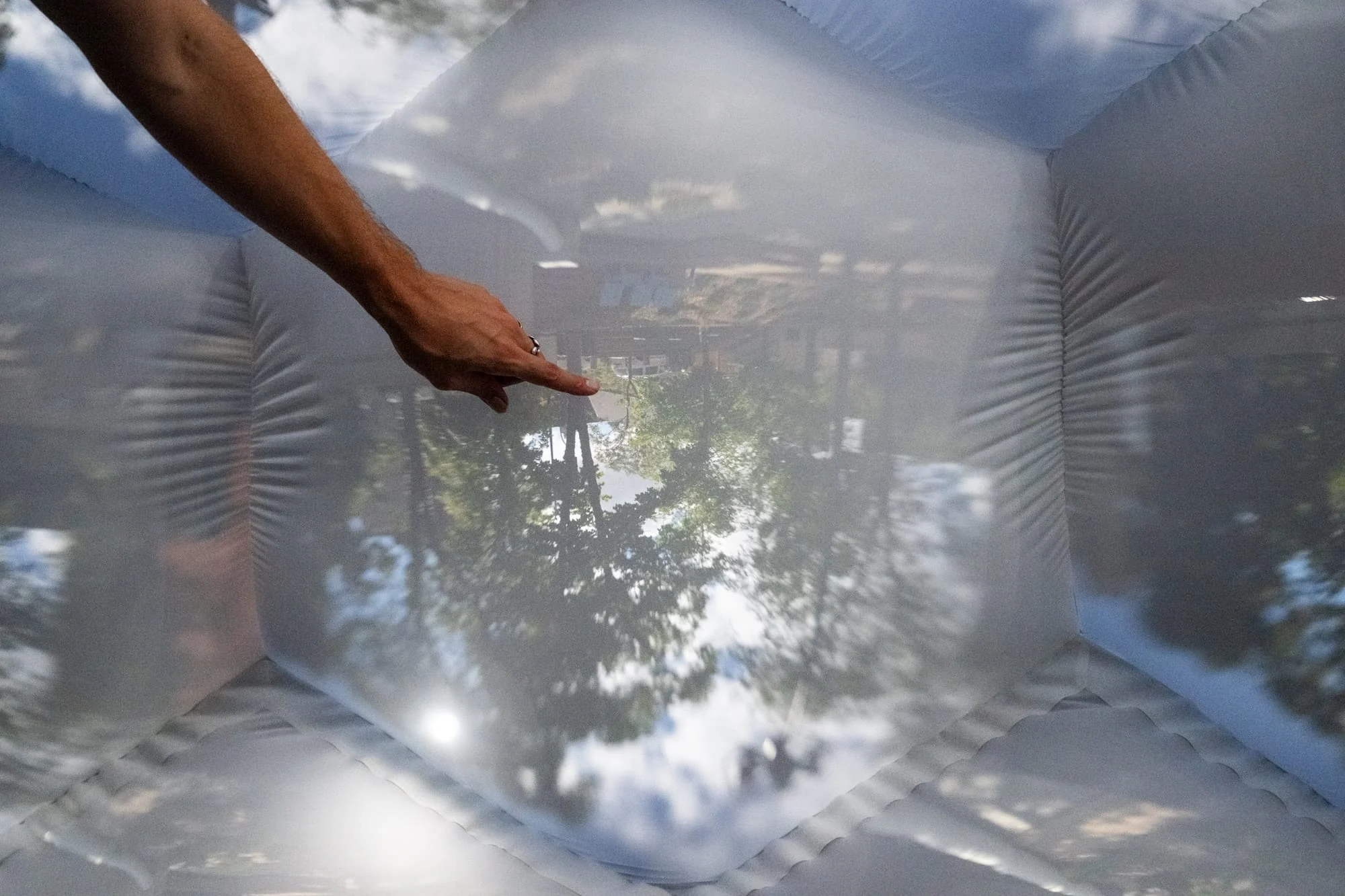
Photo: Lachlan Turczan. Courtesy Pneuhaus 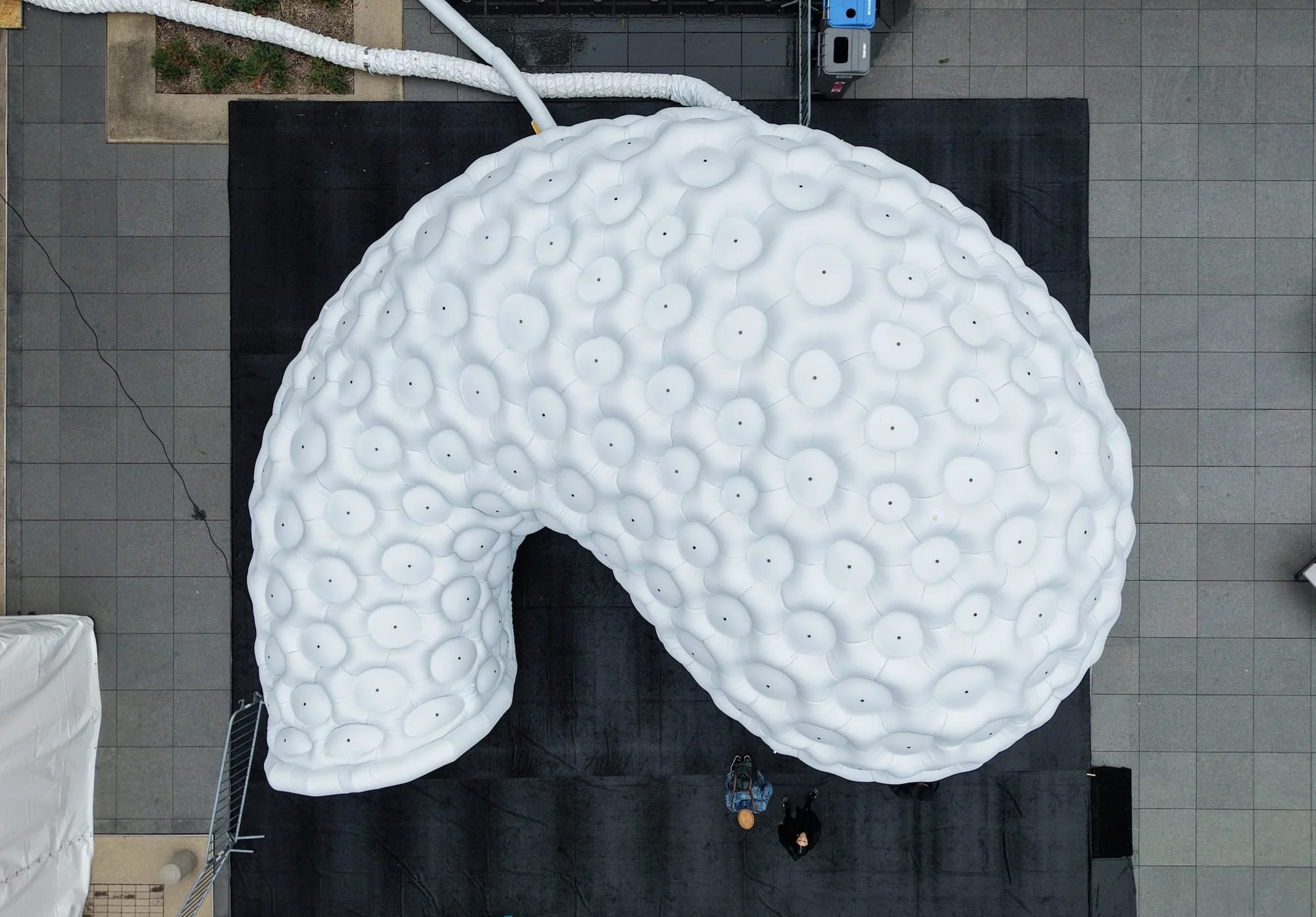
Photo: Stefan Stefanizyn. Courtesy Pneuhaus 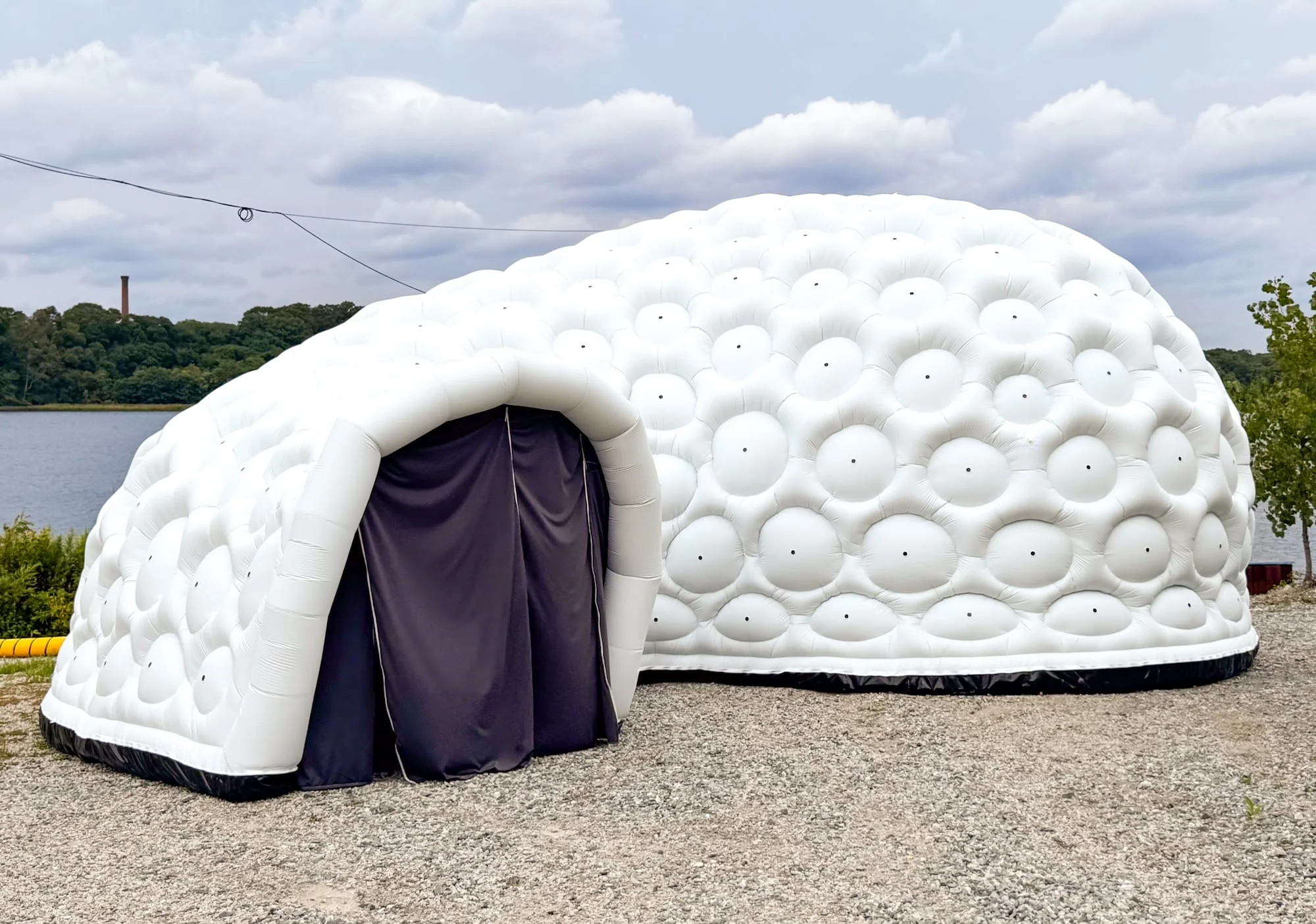
Courtesy Pneuhaus
Compound Camera 3 is a walk-in inflatable by Pneuhaus, the Rhode Island studio, premiered late last month at MODE Festival. Colossal counts 221 lenses in it, "to be exact", each one a camera obscura, across more than seven hundred square feet. The studio's own page, which describes the earlier Compound Camera, counts "109 inflatable pinhole cameras" — a different edition and, strictly, a different optic, since a pinhole has no lens. We carry Colossal's figure for this version and flag the gap. Lenses pointing up throw the sky across the interior; lenses pointing sideways throw trees, buildings and the people walking past outside. The images land on bulbous inner surfaces that a visitor can push with both hands to distort what the studio calls a bug's-eye view. There are no LED screens in it. The whole projection is powered by the sun.
This is the week's argument standing up on its own. The camera obscura is four hundred years old and nobody needed a new one; what the studio supplied was the decision about what it is for — which, in a year of licence-plate readers and doorbell cameras feeding private networks, turned out to be the exact inverse of surveillance. Two hundred and twenty-one cameras and nothing is recorded. Note what that buys technically as well as morally: no capture means no storage, no latency, no failure mode, no power. Every frame is live because there is no other option, and the brightness is whatever the sky is doing. We have specified rooms that needed a rack, a network and a cooling budget to achieve less than this does with a lens and some air.
via Colossal ↗
The title was invented to avoid paying an engineering salary

Courtesy Tina Tarighian / The Company Letter 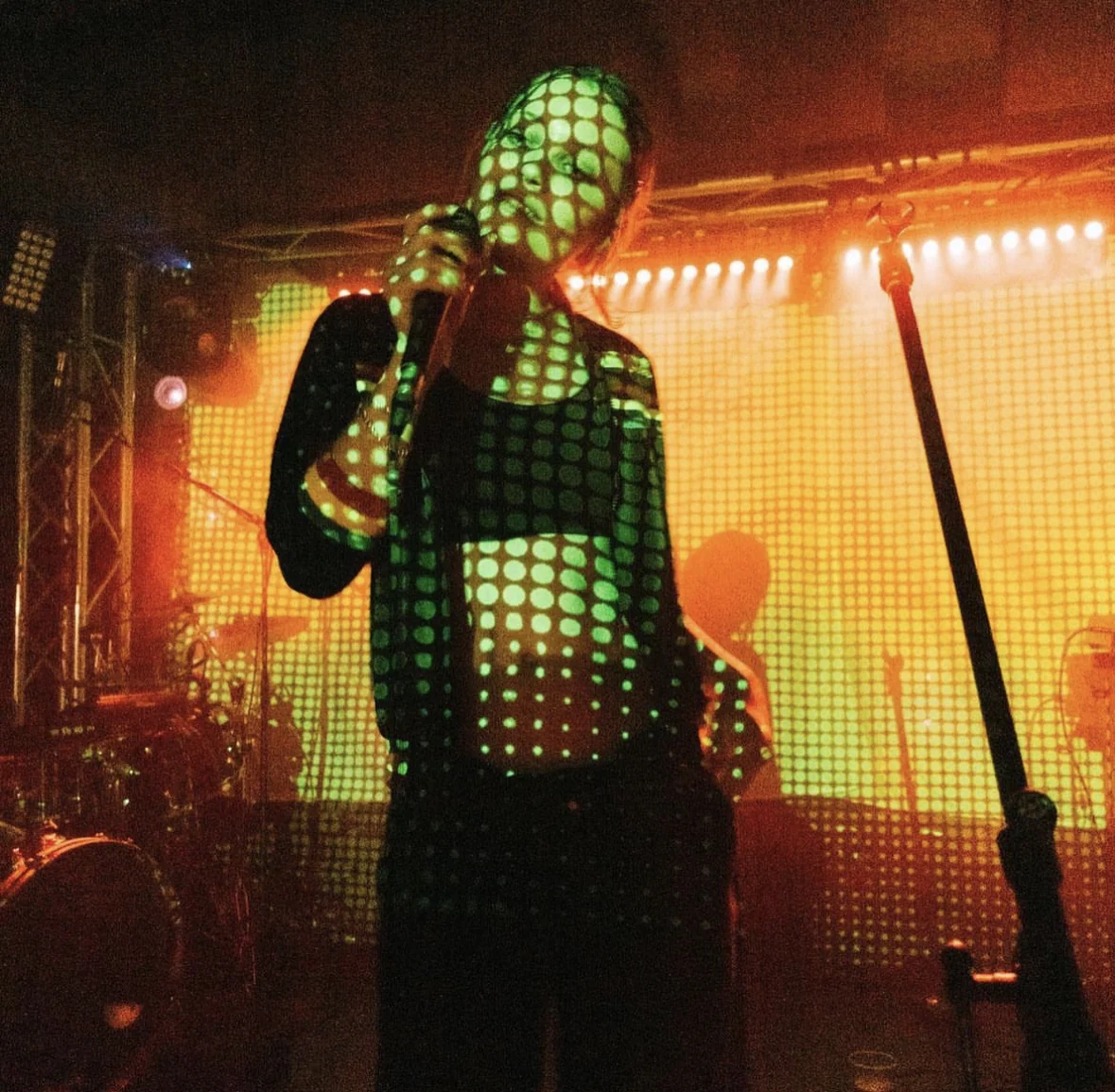
Courtesy Tina Tarighian / The Company Letter 
Courtesy Tina Tarighian / The Company Letter 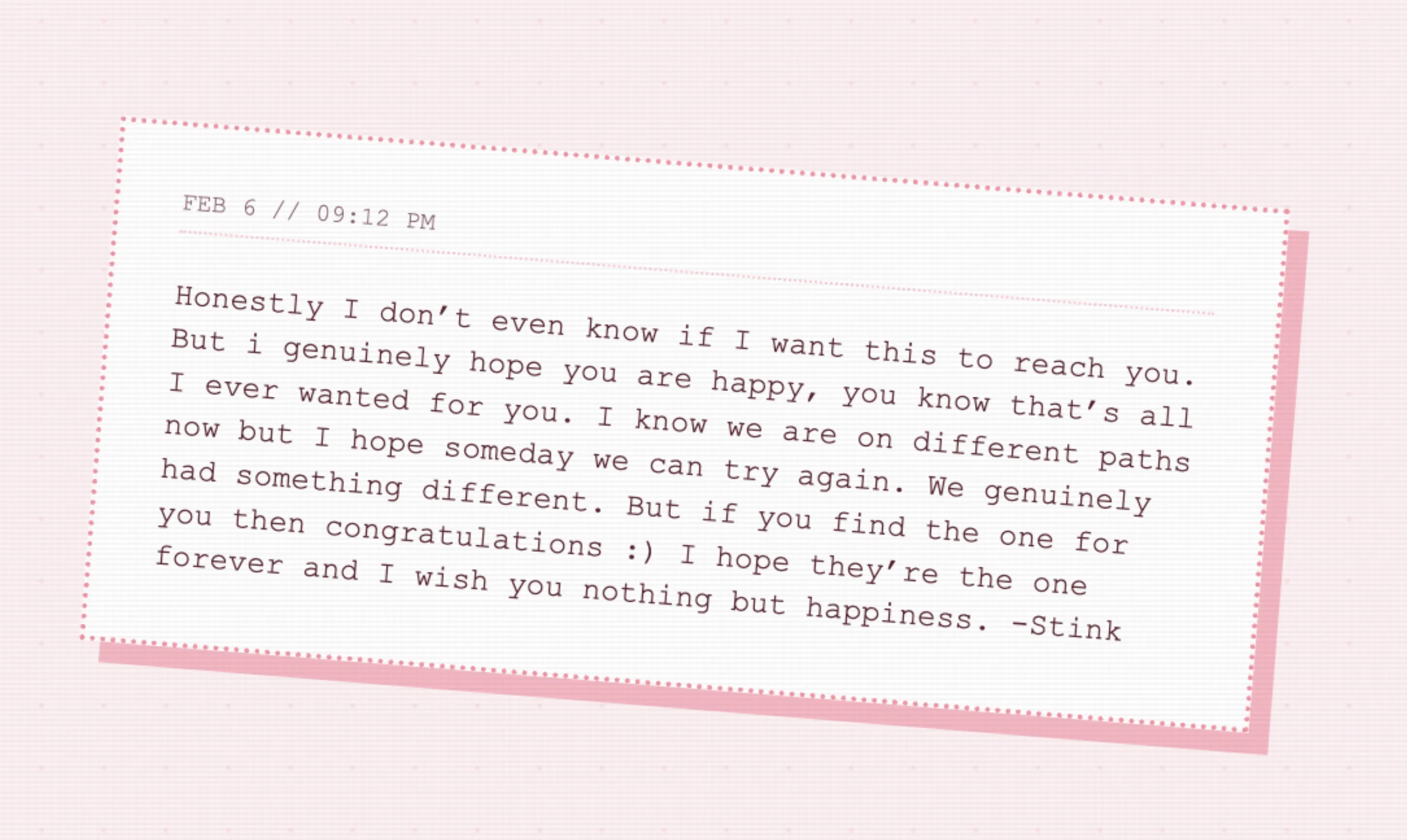
Courtesy Tina Tarighian / The Company Letter
Tina Tarighian is an artist using technology, and hers is the plainest available account of where the job title came from — the one quoted above, in which the storefront needed engineers and the budget did not want to pay for them. What makes it worth reading past the origin story is that she is also doing the work.
Her own definition is better than any of the industry ones: the job is "writing the first draft of what a technology means — sitting with something new before the obvious use cases have had a chance to calcify". The work follows from that. A purity test measuring how promiscuous you are with AI. An email lottery, built after a breakup, with a 0.0001% chance of ever reaching her ex's inbox — seen by five million people and used in more than a hundred countries. A dating app that will only match you through Instagram's algorithm. Each one borrows the trust of a format you already know how to use.
She is describing system mimicry, and it is a technique worth stealing. The purity test, the form, the dating app are all interfaces an audience has been trained on by somebody else's billions, which means the work needs no instructions and no onboarding — it starts the moment the format is recognised. That is the same economy as a borrowed room: arrive somewhere the audience already understands, and spend the budget on the thing you actually want to say. It also explains why the taxonomy will never settle. A job defined by deciding what a technology means cannot have a fixed description, because the technologies keep changing and the deciding is the only constant. The uncomfortable corollary, which Tarighian is honest about and the staffing-firm literature is not, is that a title invented to save money on engineers is still priced that way.
The first one had to patent her own colour
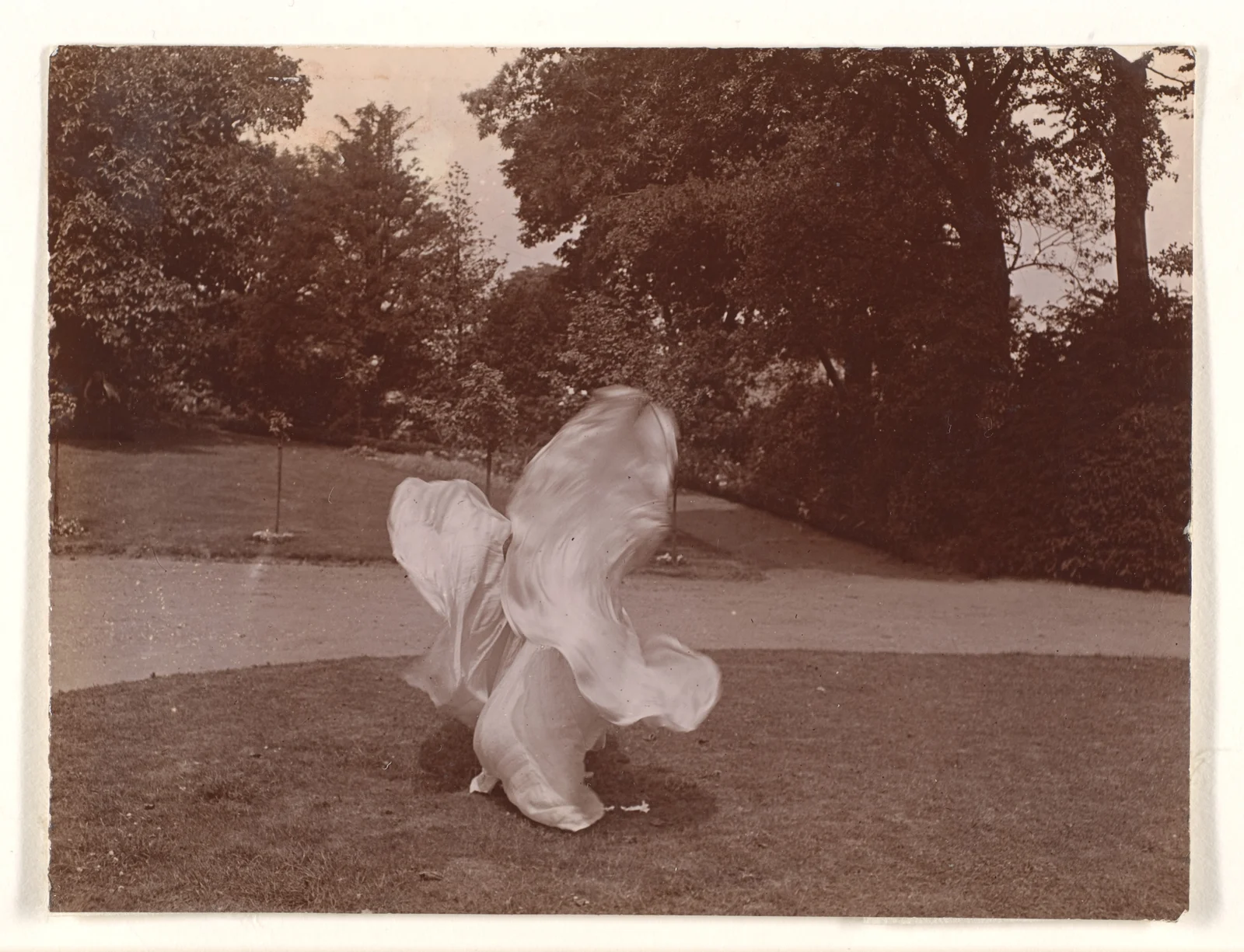
Samuel Joshua Beckett, [Loie Fuller Dancing], ca. 1900. The Metropolitan Museum of Art, CC0 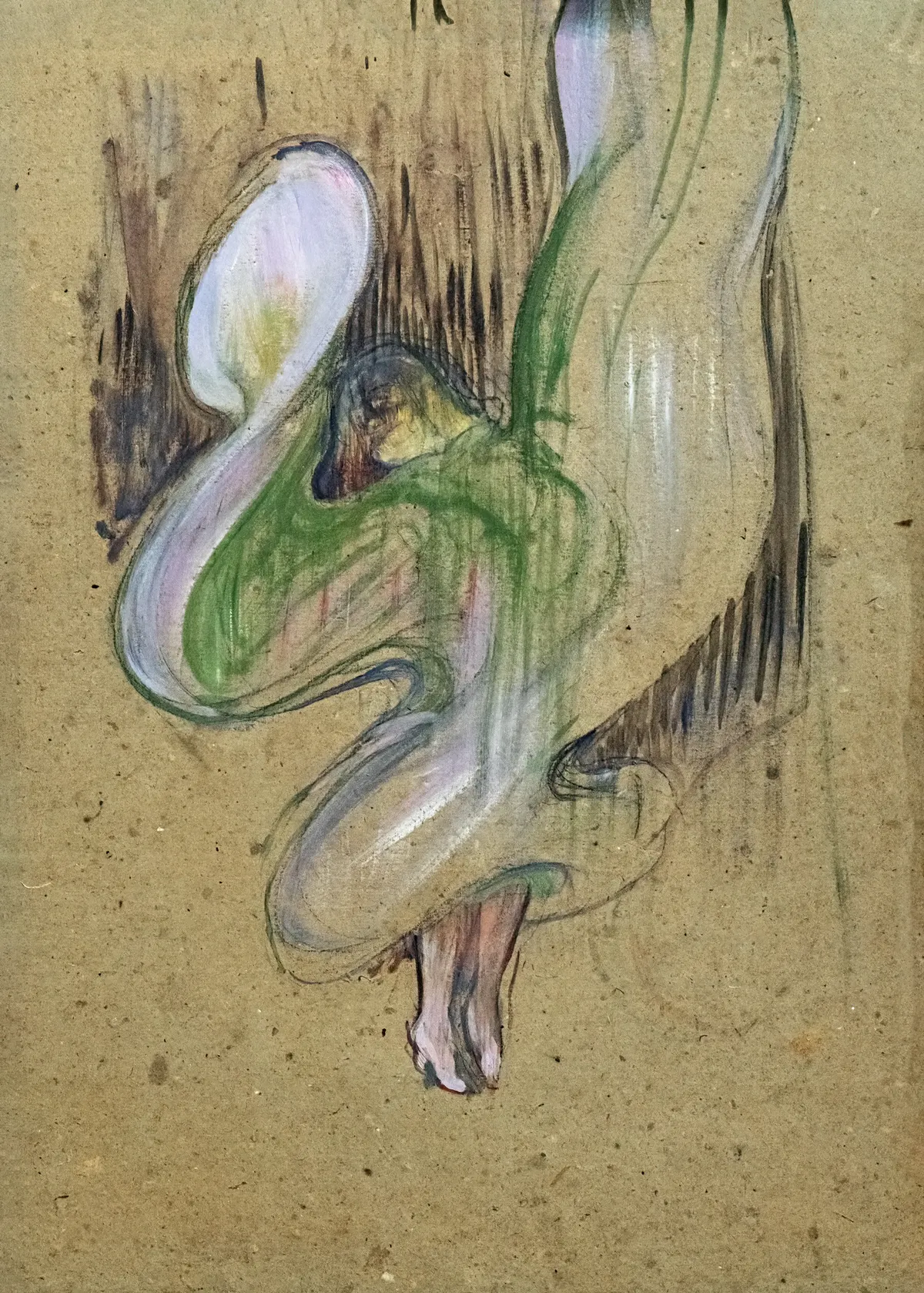
Henri de Toulouse-Lautrec, La Loïe Fuller aux Folies-Bergère (1893), Musée Toulouse-Lautrec, Albi (MTL.152). Photo: Didier Descouens, public domain 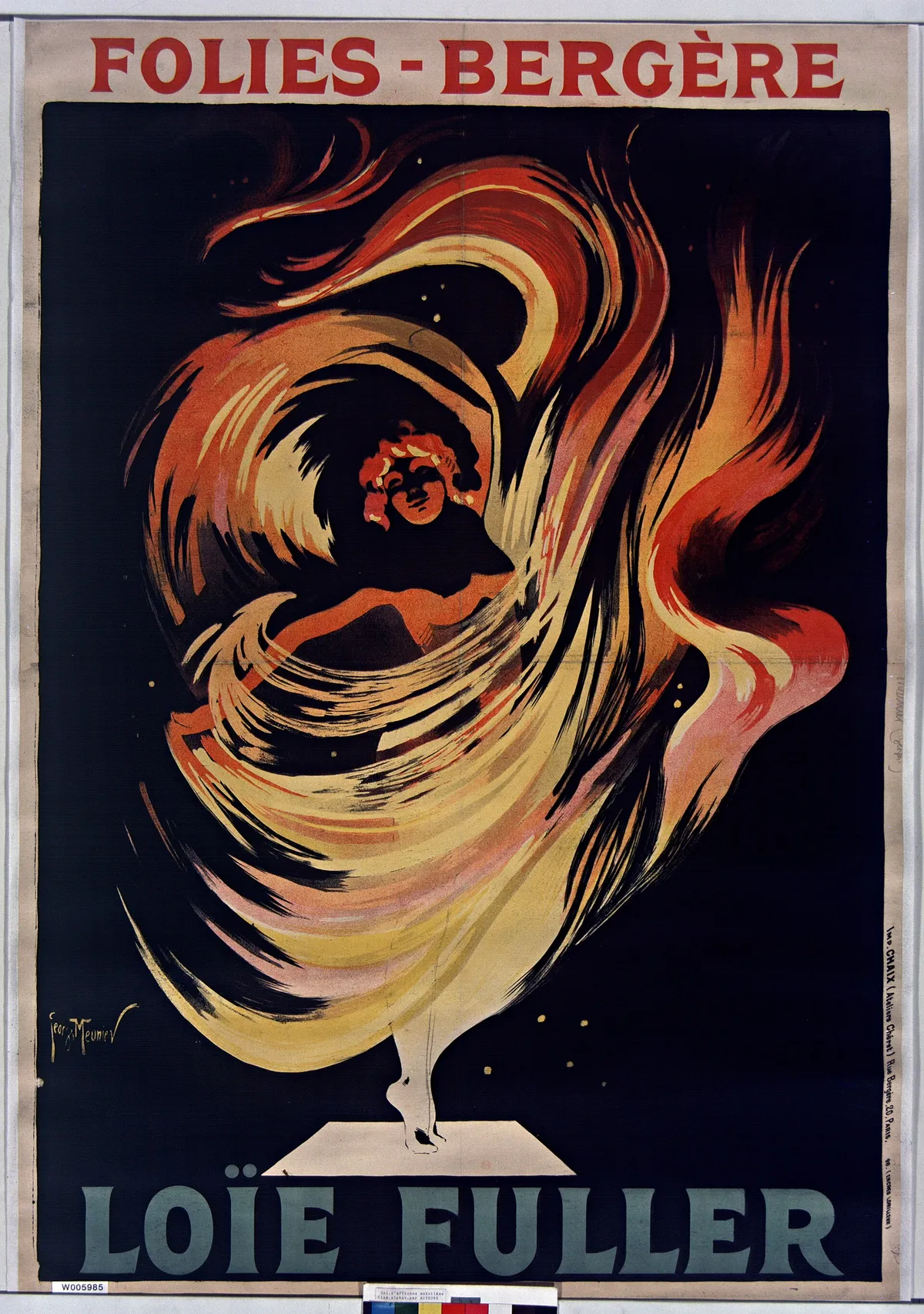
Georges Meunier, Folies-Bergère. Loïe Fuller, poster, 1898. Bibliothèque nationale de France, public domain
Fuller was combining choreography with silk costumes lit by multi-coloured lighting of her own design in the early 1890s — Wikipedia, citing Britannica, dates it to 1891, while other accounts date the breakthrough to 1892, so we give the decade. She coloured the gels herself and mounted them on revolving lamps so the colour could change at will. For Fire Dance at the Folies Bergère the floor was glass, lit from beneath. She had no technical training: Wikipedia's line is the one to keep, that she "created everything she patented herself with little knowledge of stage designs, or fabric designs." She was elected to the Société astronomique de France, and Rodin said she had "paved the way for the art of the future."
Then the part that failed. In 1892 she sued an imitator, Minnie Renwood Bemis, to establish ownership of the Serpentine Dance; she had filed a written description of it with the Copyright Office first, and the court refused her an injunction anyway. Fuller v. Bemis is still a landmark in dance copyright. So the record is precise about what this job can and cannot hold: she owned the apparatus, down to the chemistry, and she could not own the idea of what to do with it. A hundred and thirty-four years later that is still the bad news, and the reason the valuable decision keeps being the cheapest line in the budget.
The job is a hundred and thirty-five years old and spent most of that time with no title at all, which is the useful thing to know about the title. Fuller patented because there was no catalogue to buy from, and the filings say exactly what the work was — Mechanism for the Production of Stage Effects (US 513102), Garment for Dancers (US 518347), Theatrical Stage Mechanism (US 533167). One of those three is a dress. She worked both ends of the beam, the lamp and the silk it lands on, and a brief that treats fabric, light and movement as separate trades is arguing with a dancer who did not.
via Loie Fuller ↗
Es Devlin: Other Worlds
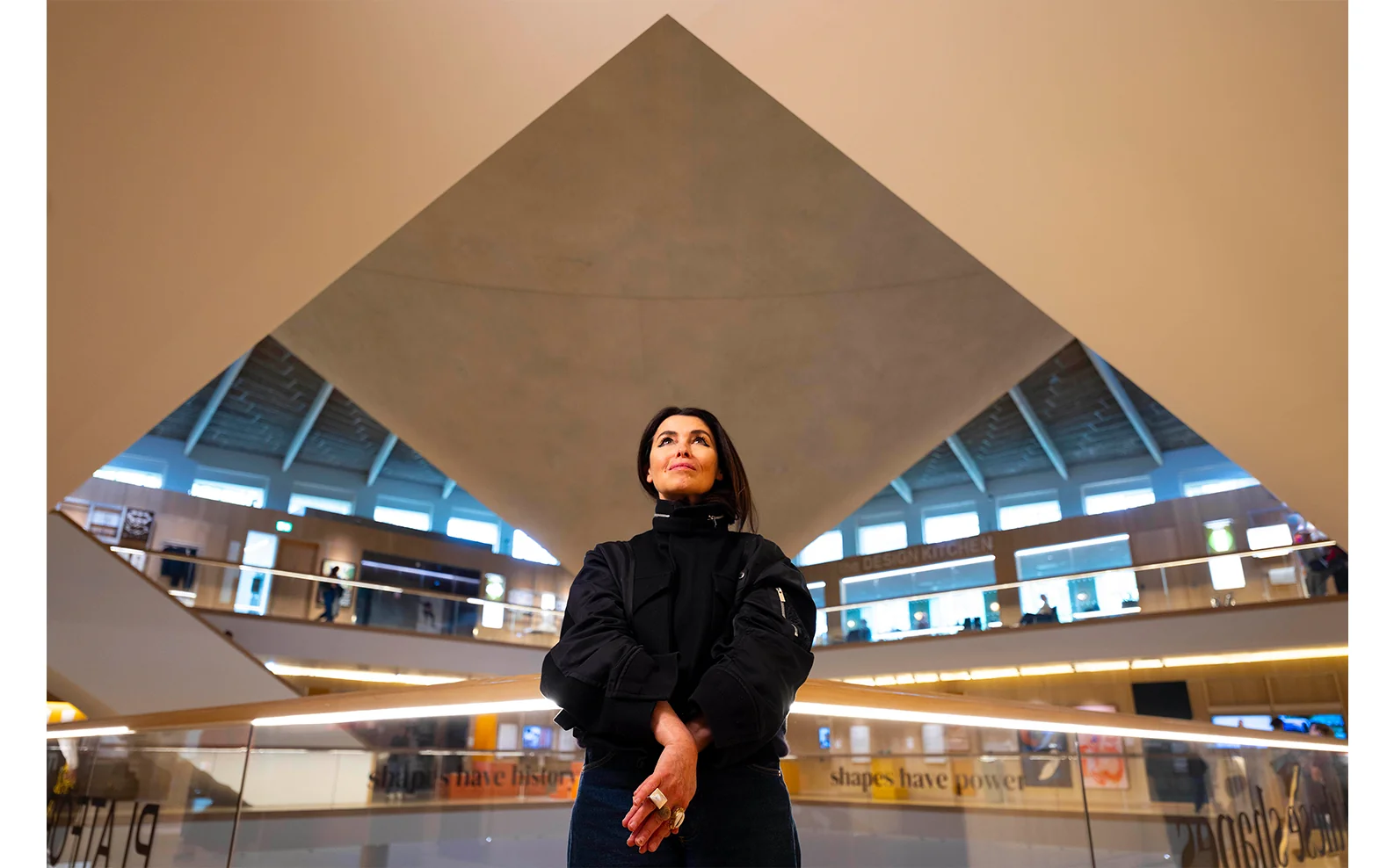
London, 2 October 2026 to 4 April 2027. The museum calls it "the first retrospective in Europe celebrating her 30-year creative practice across sculpture, stage design, music, language and light". The one to stand in front of is Infinite Library, whose books come from Penguin Random House UK and go to local charities when the show closes, in support of the National Year of Reading 2026.
via Design Museum ↗
Biennale ELEKTRA 2026: F(R)ICTION
Montréal, 15 October to 15 November. The eighth ELEKTRA biennale takes the video game as its subject — F(R)ICTION : art et jeux — across a month of exhibitions and encounters. Opens today.
via ELEKTRA ↗
Dutch Design Week
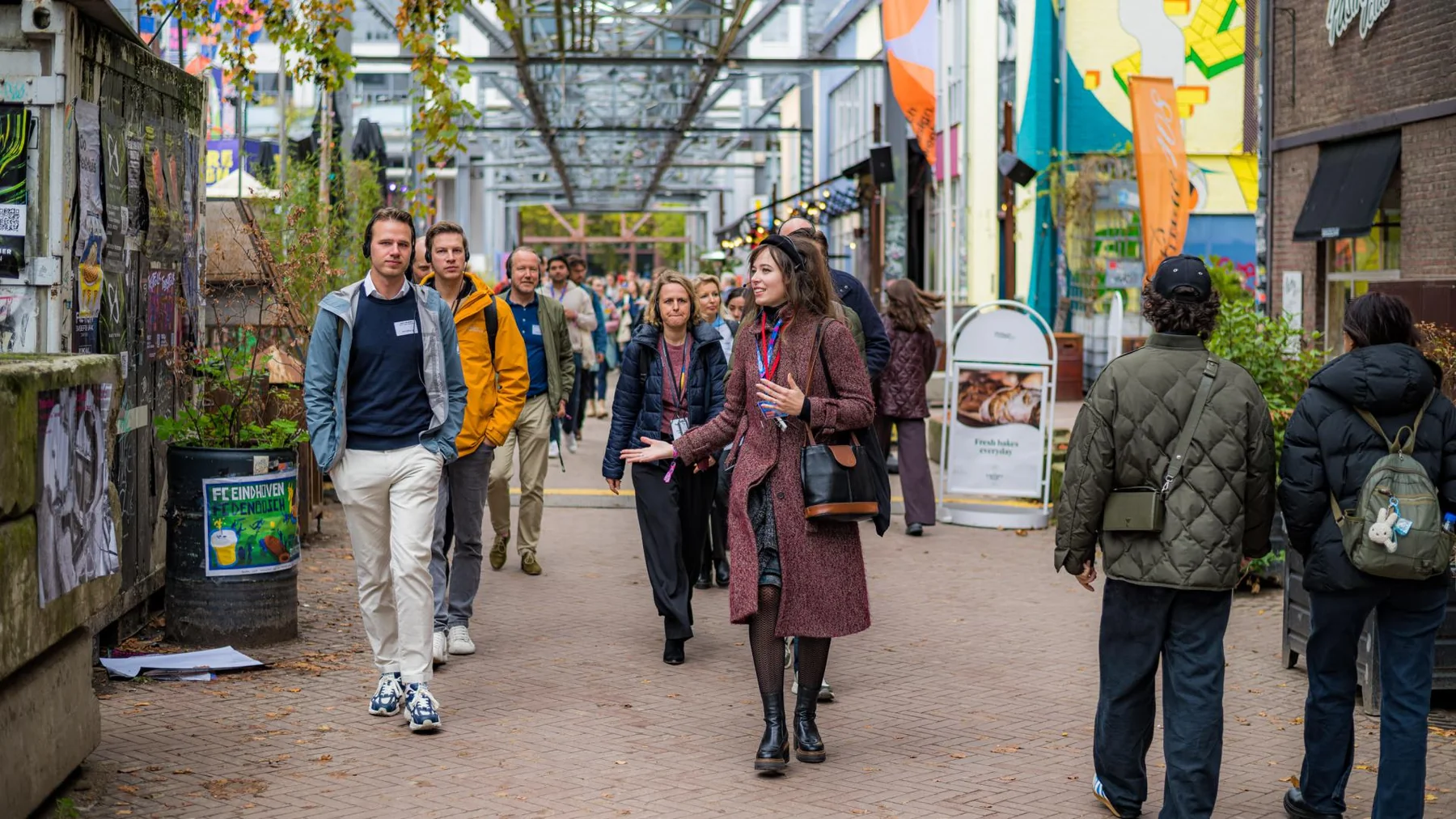
Eindhoven, 17 to 25 October, nine days. Upcoming rather than on now — it opens the day after this issue — and it is the one week of the year when a whole city's worth of unfinished work is put where people can argue with it.
via DDW ↗
Radiant Geometries
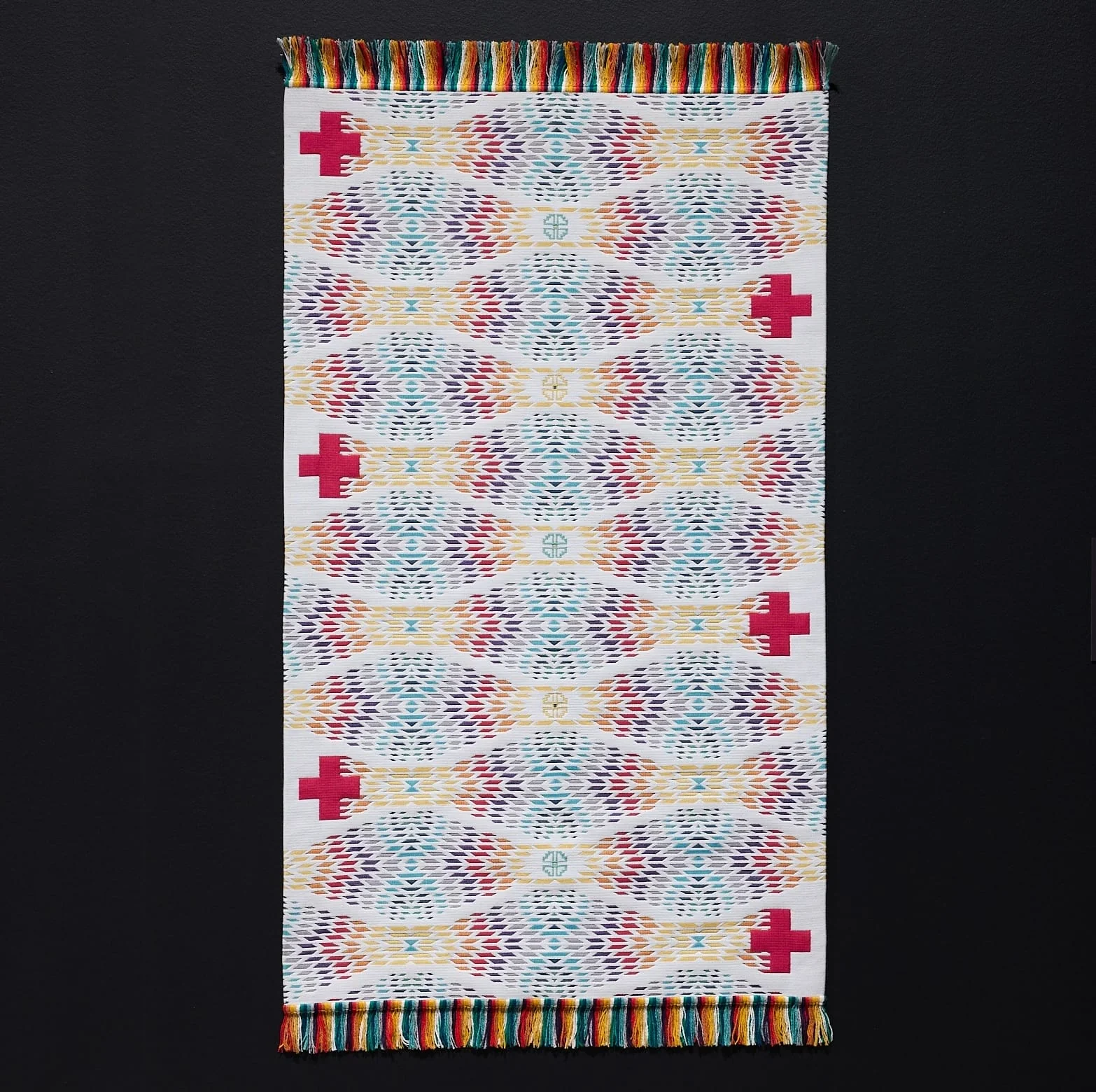
Houston, through 19 December, curated by Noor Alé: Indigenous mathematics, science and architecture across the Americas. Melissa Cody works a vertical Navajo loom and a mechanised Jacquard machine in the same practice, which is this issue's argument in textile form.
The rest of the month is on the Calendar.
Curated by Neves Creative. Every item links to its original source.