Thirty Million Pixels, and None
This week: a 42-metre stadium screen that counts every pixel, eleven metres of light tunnel lined with a mirror, a laser performance with no one on stage, and two installations to see.
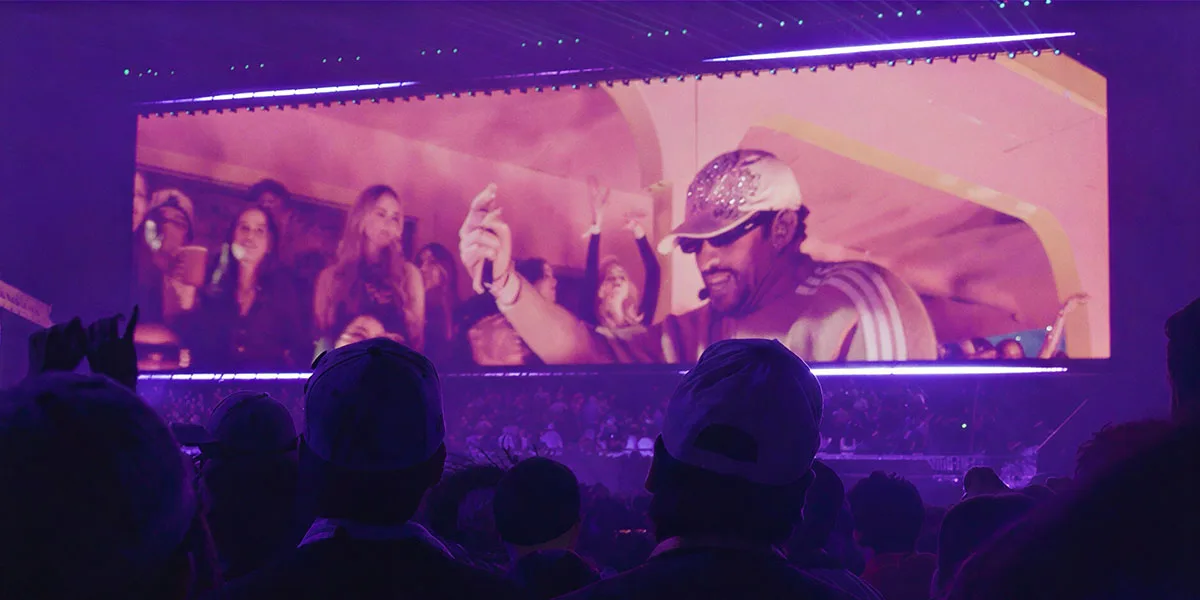
Bad Bunny's Debí Tirar Más Fotos tour carries one LED screen across the back of a stadium stage: 42 metres wide, 11 high, 10,752 by 2,816 pixels, built from 462 INFiLED Black Widow AMT panels. TPi prints those numbers from Brompton Technology's account of the tour. They check against each other. Multiply 42 by 11 and you get 462, so the screen is one panel per square metre, and 30,277,632 pixels across 462 panels is exactly 65,536 each. The part we would not have guessed is where the picture comes from. More than 90 per cent of the show is cinema-camera footage, and the panels were chosen by the artist, in a shootout between LED products, during a residency in Puerto Rico.
Thirty Million Pixels, and None
The screen in the Lead is a count. Thirty million pixels, each one assigned to a panel, each panel to a processor, each processor to a feed. Every decision that matters on that wall can be written as a number, and the people who built it did exactly that.
Robert Henke's FIRST LIGHT, at the Barbican on Saturday, is the other kind of image. Henke describes his laser graphics as "a very narrow focused beam of light, drawing shapes on a screen by precisely moving mechanical mirrors". There is no grid to count, so every decision moves into the software, where Henke has been building since 2020. One show leaves nothing about the picture to chance between the camera and the panel; the other takes the performer off the stage altogether. In both, the audience looks at the result and never at the decision.
Sabine Marcelis, whose first museum show opened in Zurich on 30 October, takes a third route: 125 lamps and one mirror wall make an eleven-metre walkable tunnel. You see twice the lamps the museum bought.
None of them is better than the others. The claim is only that 30,277,632 is not the same as the moment that stops a stadium. None of the three counts that.
Bad Bunny picked a 462-panel stadium screen in a Puerto Rico shootout
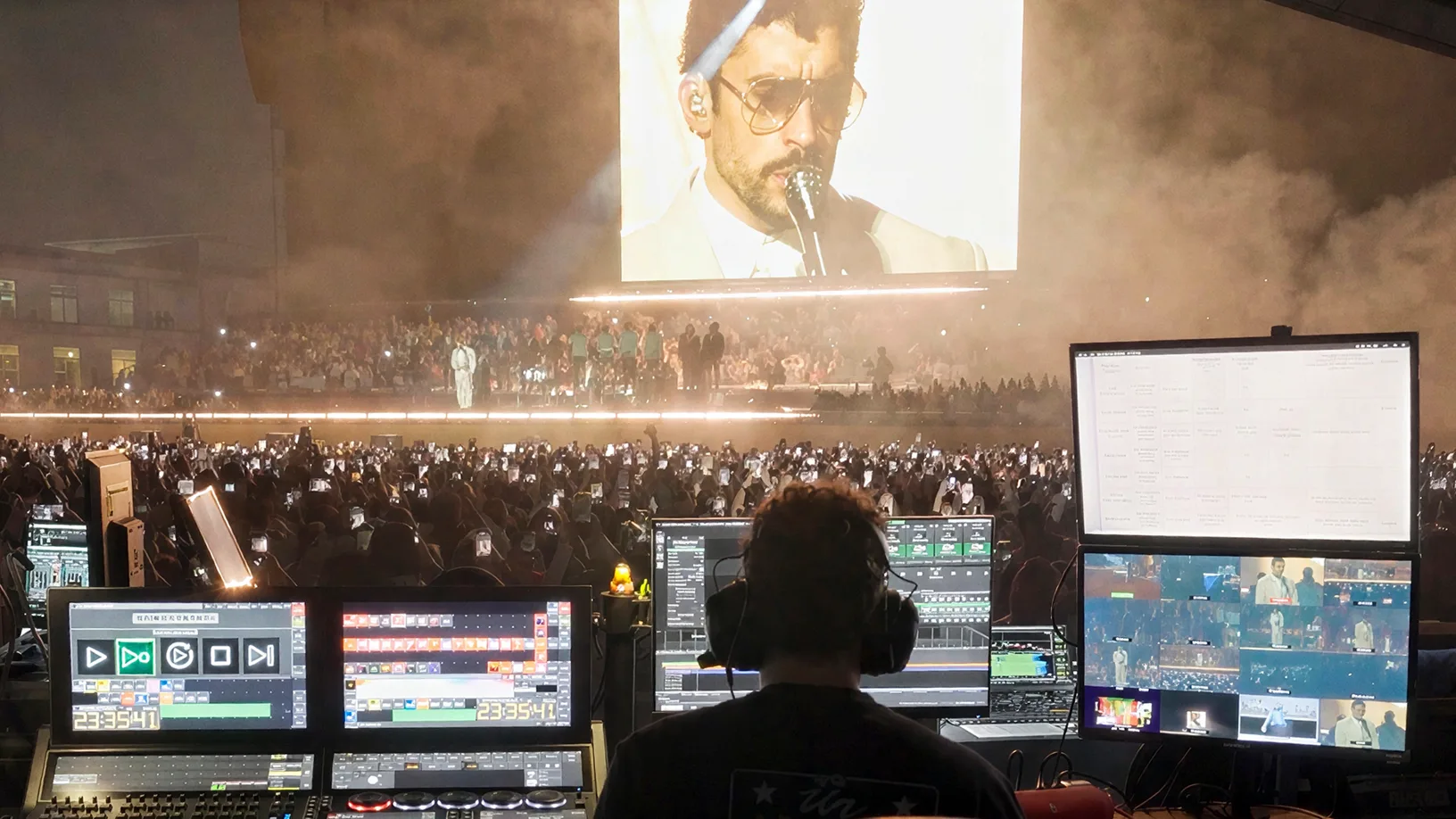
Bad Bunny chose the panels himself, in a shootout between LED products, during a 31-show arena residency in Puerto Rico. What he chose is driven like this. Four Tessera SX40 processors each feed four XD 10G distribution units, with Brompton's "closed-loop cable redundancy system", which TPi says runs "across two XD units per screen". Two delay screens, stage right and left, run from a further SX40. The figures come from TPi, quoting Pieter Laleman, the tour's Video Technician and Head of LED. Rather than working with custom resolutions, the team took four UHD feeds from a bank of Disguise GX 3+ media servers.
What goes on the wall is mostly photographed. TPi says over 90 per cent of the show is built around cinematic imagery shot on 4K Sony cinema cameras, some of it treated with Notch effects. That is why the colour path matters. The team ran a 10-bit workflow with custom LUTs, and Laleman says running everything in 10-bit "gave us so much extra detail in the camera images". The panels were sourced by Production Video Group and "personally selected by the artist during a 31-show arena residency in Puerto Rico, where a shootout between different LED products took place". The run was 57 stadium shows in about 20 countries, November 2025 to August 2026.
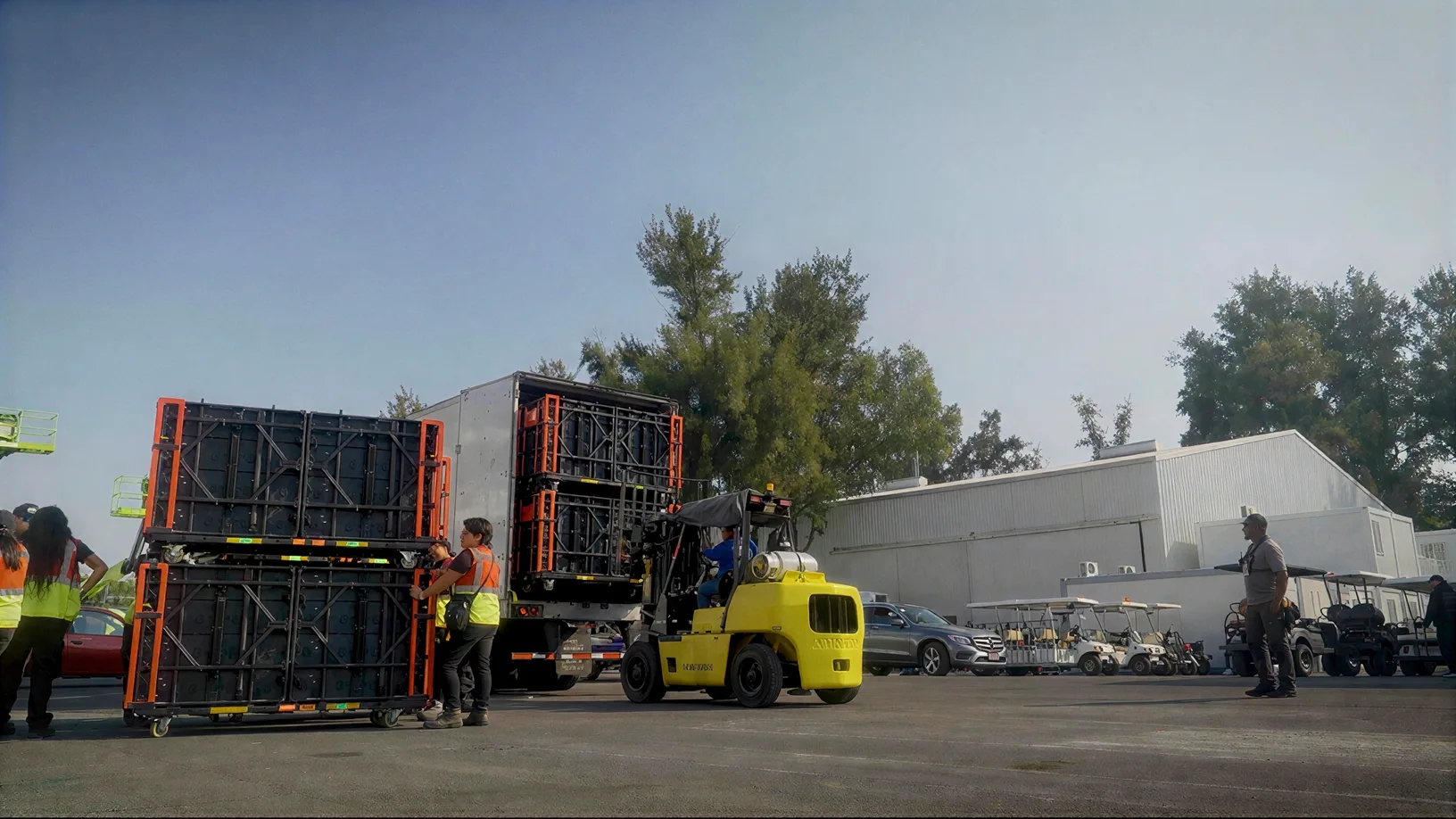
The build is the part worth stealing. The cabinets are "safely climbable", so the wall goes up in large sections rather than panel by panel, with "vertical positioning columns and side hasp locks" to align them. INFiLED says the screen "takes only six hours to build", delivers "30% more LEDs per standard tour truck" and "reduces weight by more than 5,000 kg, compared to similar tour setups."
The Lead's arithmetic is ours, not the sources'. TPi and Brompton print no panel size and no pixel pitch. INFiLED's own page gives Black Widow AMT at 3.9 mm in cabinets of 1,000 × 1,000 mm, which is where a cabinet of 256 × 256 pixels comes from. The trade title invidis describes each panel as a metre square. Those are two sources independent of TPi, and they agree. The sources differ on one point we have not resolved: TPi says four UHD feeds from a bank of Disguise servers, INFiLED says four GX 3+ servers. And TPi's article is Brompton's release with a masthead on it, so it is one source, not two. None of the three pages describes the lighting.
Sabine Marcelis built an eleven-metre light tunnel out of 125 lamps and one mirror
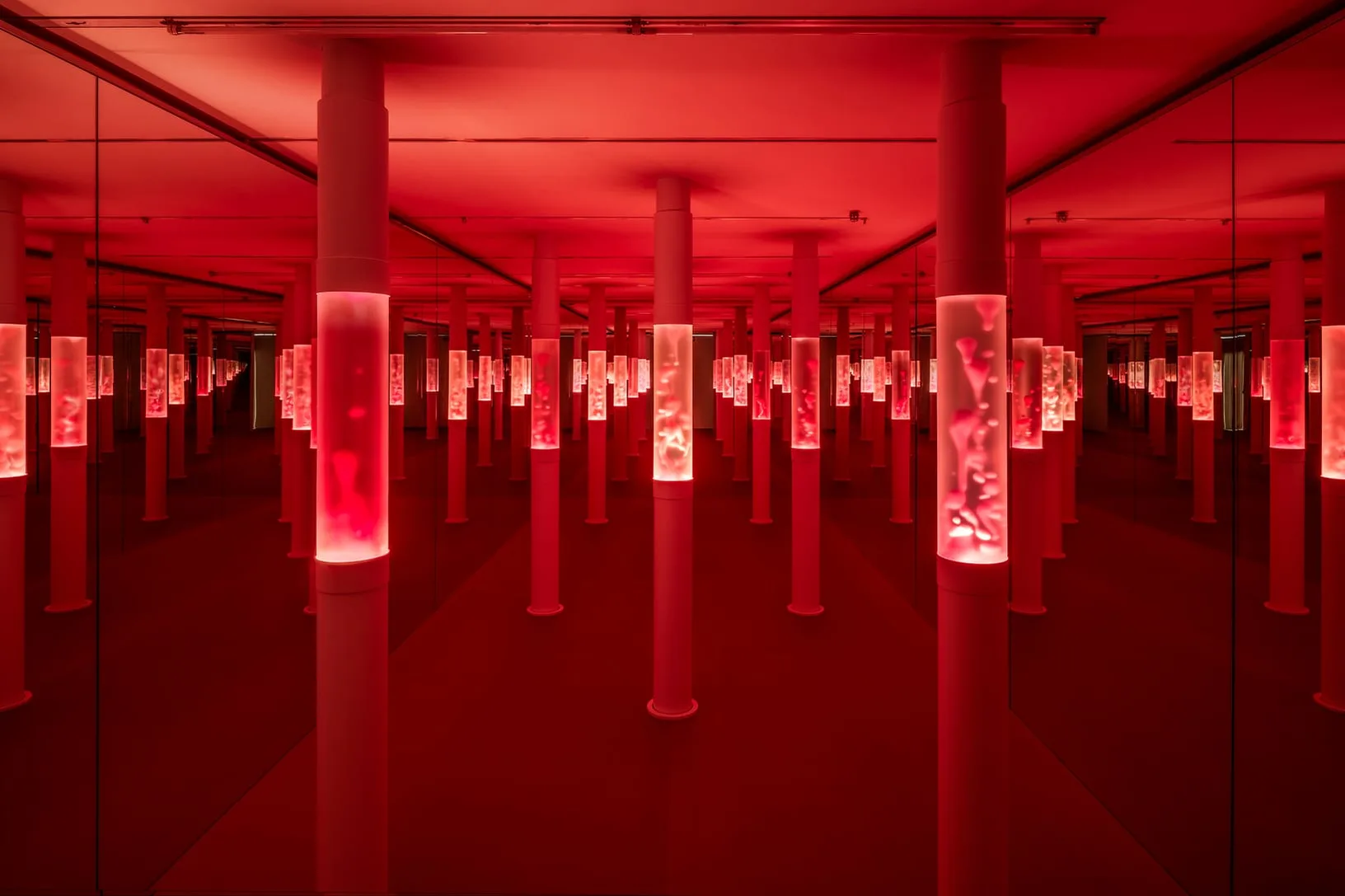
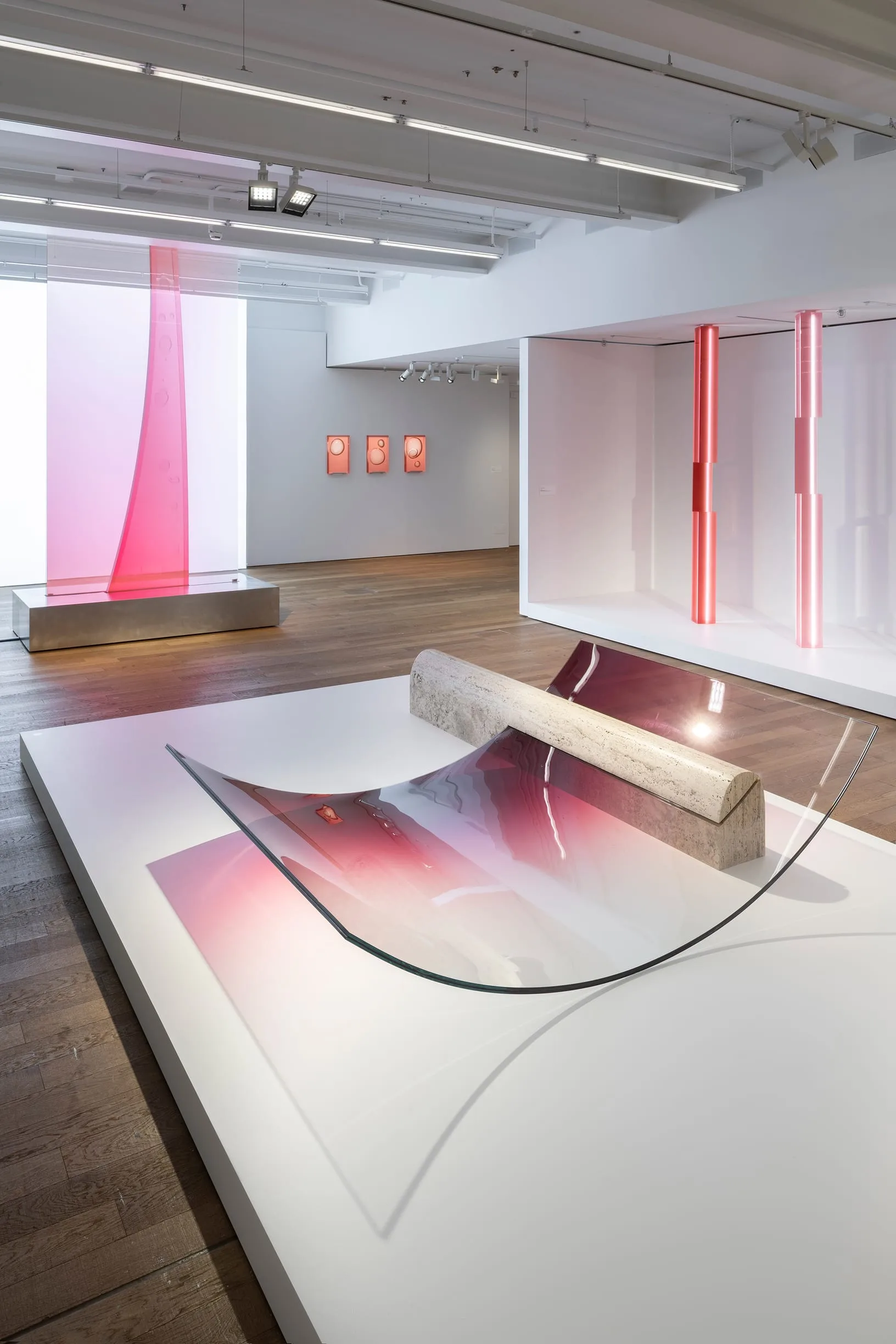
Zurich, 30 October 2026 to 4 April 2027, at the Toni-Areal. The museum calls this "Marcelis's first museum exhibition", combining "central groups of works from recent years with site-specific light works". Two rooms do the same thing: a mirror multiplies a lamp count, and the museum prints the count each time.
The VARMBLIXT tunnel is 125 lamps: "eine Installation aus 125 Leuchten, die durch eine Spiegelwand mit Farbverlauf zu einem elf Meter langen, begehbaren Lichttunnel wird." One wall of lamps, one mirror wall carrying a colour gradient. In the installation view the real wall reads yellow and the mirrored one reads red. That is the gradient earning its keep. The two sides of the corridor are not the same colour, so the mirror never announces itself as a mirror. The lamps come from VARMBLIXT, a collection of about 20 objects Marcelis developed with IKEA.
The Mathmos room does it again with a smaller number: "aus acht Leuchten und Spiegelwänden", eight lamps and mirrored walls, in a room that "dehnt sich … scheinbar ins Unendliche aus" — appears to stretch to infinity. Eight. The lamp itself, from what the museum calls a longstanding collaboration with Mathmos, is "fast drei Meter hoch", almost three metres tall.
The museum says the 125 lamps become an eleven-metre tunnel "durch eine Spiegelwand", without saying whether the mirror doubles the corridor's length or simply gives a wall of lamps its second side. The installation view shows it running along the corridor, which is the second reading, so we are not claiming the mirror fakes half the length. Either way you walk past twice the lamps that were bought. The museum publishes the count, and a show willing to tell you it is eight lamps is making the mechanism the subject.
Robert Henke is putting no one on stage and running the lasers from the audience
FIRST LIGHT has its world premiere at the Barbican on Saturday 7 November at 20:30, "roughly 75 mins long, with no interval", with "lasers, haze and strobe". Henke's page is plain about the staging: "For FIRST LIGHT, no one is present on stage." Henke himself, the page says, "is controlling the machinery from within the audience, part facilitator, part observer."
The machinery is FirstLightEngine, "a laser graphics software developed since 2020 by Robert Henke, based on MaxMSP", driving laser projectors from LaserAnimation Sollinger Berlin, with additional laser graphics programming by Jonas Margraf.
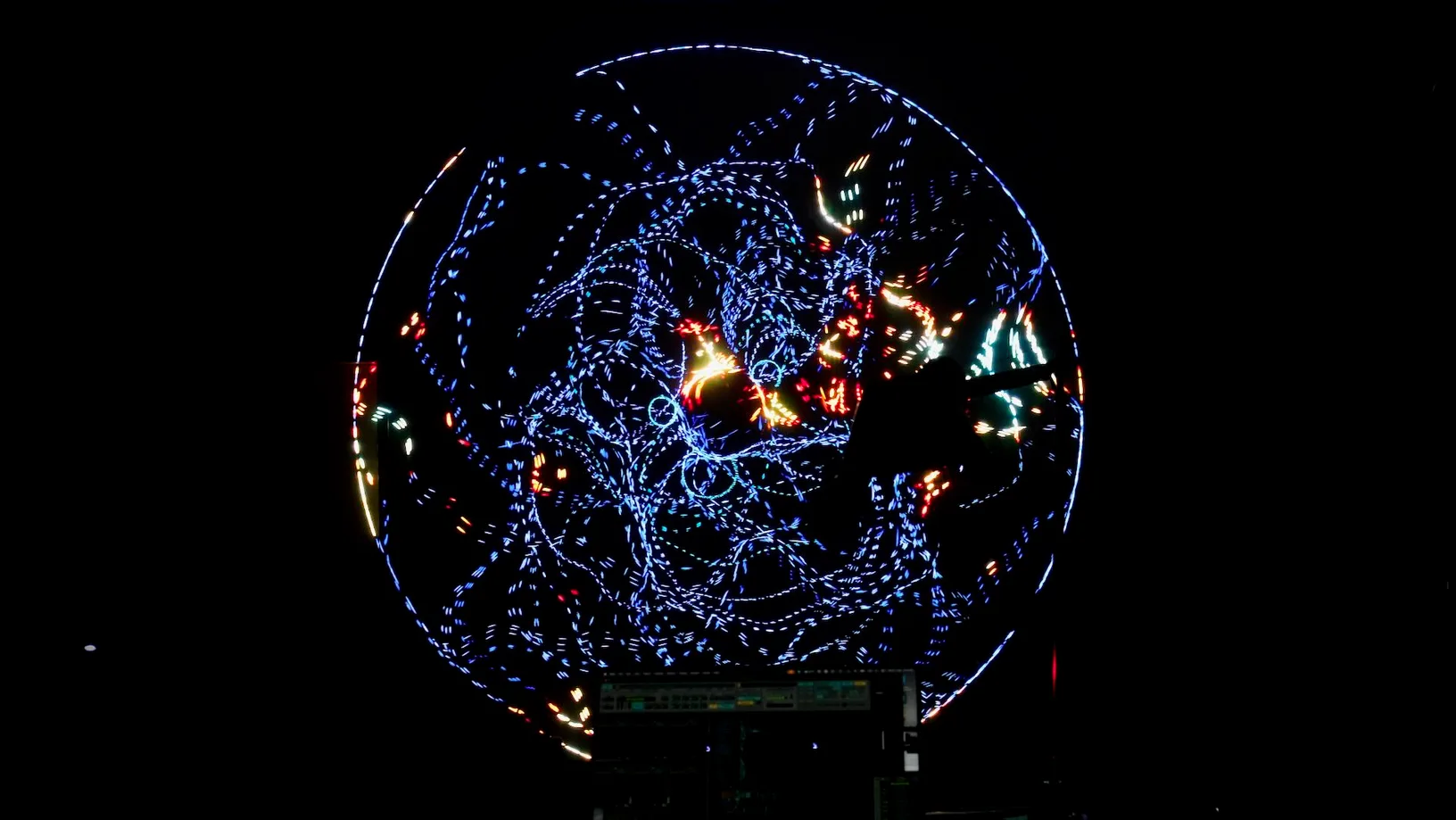
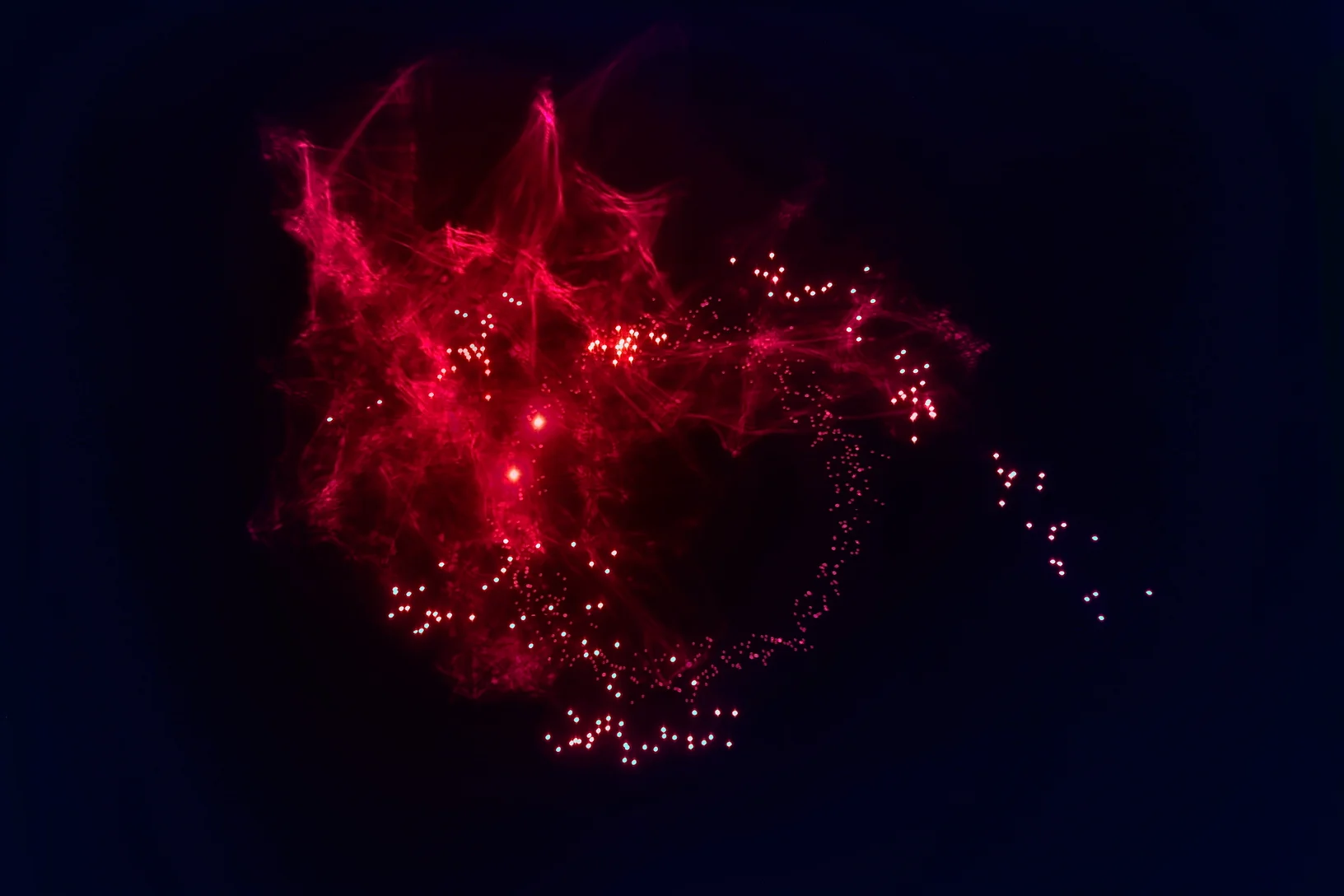
Two of the five pictures Henke publishes are worth a second look, because the apparatus is in the frame with the image: below the drawn light in both, at desk height, sits a screen carrying the running software. Neither is dated, and neither shows the Barbican, but the arrangement is the one the piece describes — no stage, no figure, a desk in the dark under the thing it is drawing. In the colour frame the lines break into dashes, which is the beam blanking as it crosses the gaps between the parts of a shape.
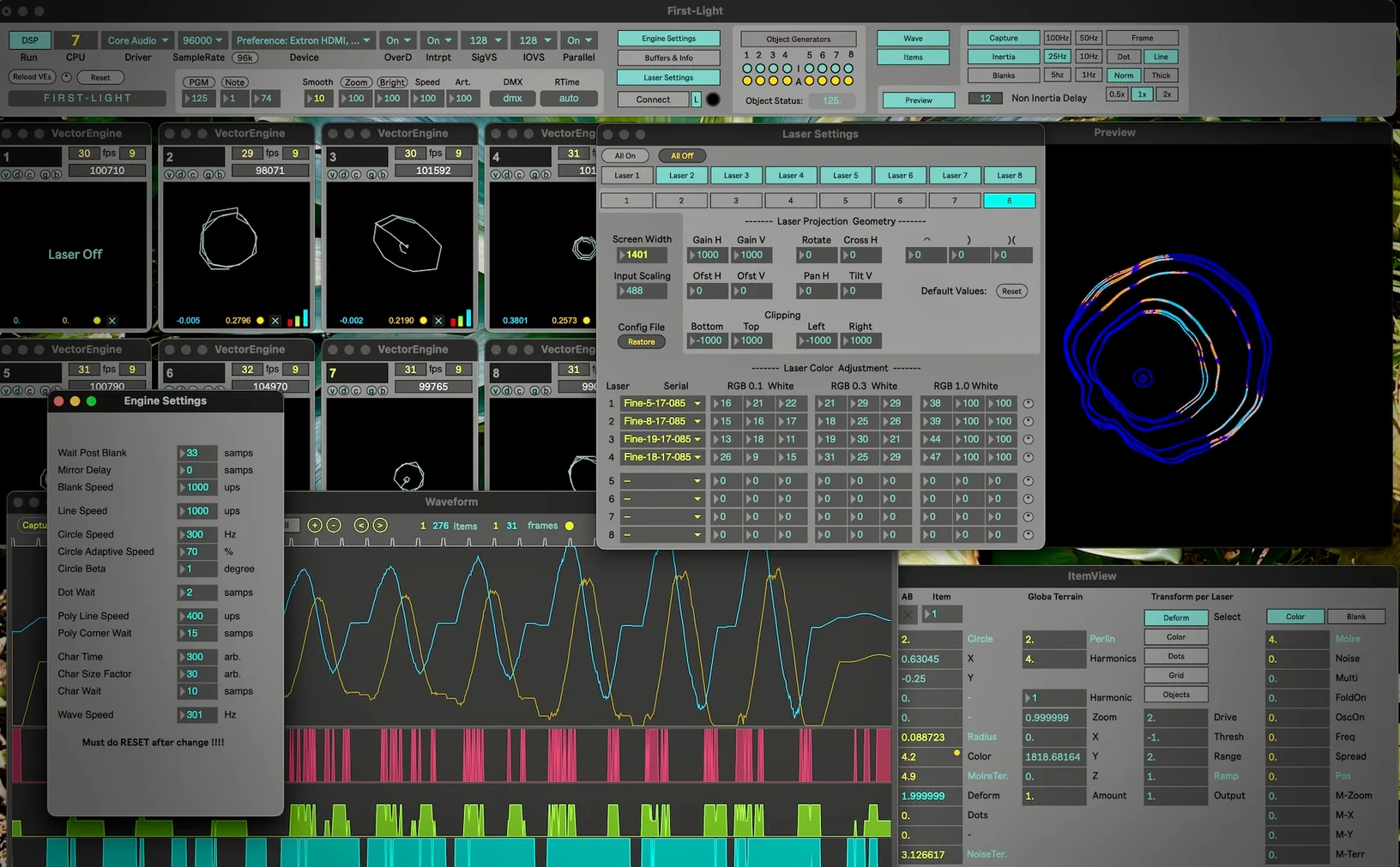
The one captioned picture, the FirstLightEngine screenshot, is the nearest thing to a plan anyone has published. It shows eight VectorEngine instances, each reporting its own frame rate and point count. A Laser Settings panel carries per-laser gain, rotation, pan, tilt and clipping. A colour calibration table holds serial numbers in four of its eight laser slots. Timing is exposed down to mirror delay, blank speed, line speed and the wait after each polygon corner, which is the real cost of drawing with a beam: everything is drawn by moving mirrors, so every shape is a schedule. What it cannot show is the Barbican rig.
The Barbican prints a dedication: the work "is dedicated to the female astronomers, astrophysicists, engineers, computer scientists, and mathematicians who contributed so much to our knowledge of the universe, yet often enough did not get the recognition they deserve."
Marshmallow Laser Feast: All That Is Unseen
Doha, at the Media Majlis Museum, to 21 January 2027, free, Sunday to Thursday. The museum says it is MLF's first exhibition in Qatar and its debut in the Middle East, made in partnership with ACMI. The photograph is of the 2023 ACMI edition, not the Doha installation.
Laurent Grasso: Metaphysical Maze
North Adams, opens Saturday 7 November, three X-shaped structures spanning MASS MoCA's former industrial space; the museum calls it "the largest exhibition to date in the United States devoted to French conceptual artist Laurent Grasso". The Olana and Thomas Cole companion shows open 22 November.
Curated by Neves Creative. Every item links to its original source.